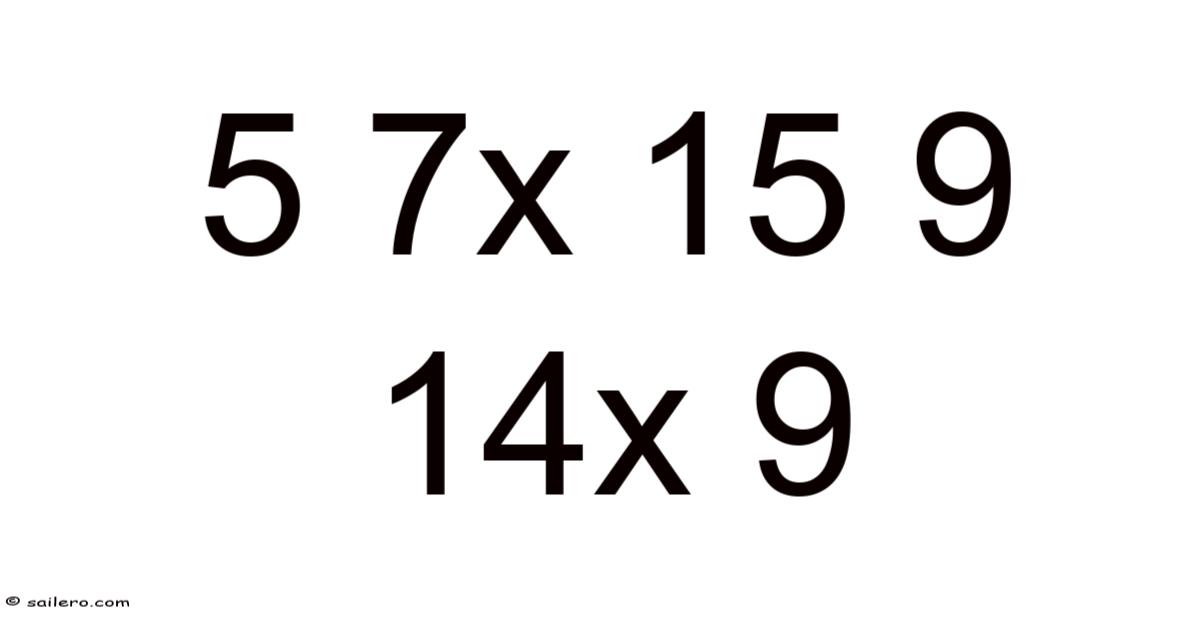
Understanding the Sequence: 5, 7x15, 9, 14x9
The sequence "5 7x 15 9 14x 9" presents a unique combination of numbers and mathematical operations that can be interpreted in multiple ways. At first glance, it may seem like a random assortment of digits and multipliers, but upon closer examination, it could represent a mathematical problem, a pattern, or even a code. Here's the thing — this article explores the possible meanings behind this sequence, breaking down each component and analyzing its potential significance. Whether you’re a student, a math enthusiast, or someone curious about numerical patterns, understanding this sequence can offer valuable insights into how numbers interact in different contexts Easy to understand, harder to ignore..
Breaking Down the Components
To fully grasp the sequence "5 7x 15 9 14x 9," it’s essential to analyze each element individually. The numbers 5, 7, 15, 9, 14, and 9 are all integers, while the "x" symbols indicate multiplication. This means the sequence includes both standalone numbers and products of multiplication.
- 7x15 equals 105
- 14x9 equals 126
Substituting these values into the sequence, we get: 5, 105, 9, 126. This revised sequence removes the multiplication symbols and presents a series of numbers that may now be easier to analyze. Also, the question now becomes: what is the relationship between these numbers? Are they part of a mathematical pattern, a code, or something else entirely?
Possible Interpretations of the Sequence
-
Mathematical Pattern or Sequence
One of the most straightforward interpretations is that this sequence follows a specific mathematical pattern. Still, the numbers 5, 105, 9, 126 do not immediately suggest a clear arithmetic or geometric progression. For example:- The difference between 5 and 105 is 100.
- The difference between 105 and 9 is -96.
- The difference between 9 and 126 is 117.
These differences are inconsistent, which rules out a simple linear pattern. Similarly, there is no obvious multiplicative relationship between the numbers. This lack of a clear pattern might indicate that the sequence is not meant to be analyzed as a traditional mathematical sequence but could instead represent something else Surprisingly effective..
-
A Code or Cipher
Another possibility is that the sequence is a code or cipher. Numbers can sometimes be used to represent letters (e.g., A=1, B=2, etc.), but in this case, the numbers are too large to fit within the standard 1-26 range. That said, if we consider the original sequence with multiplication symbols, it might be a more complex cipher. For instance:- "5" could represent a specific letter or symbol.
- "7x15" might be a code for a word or phrase.
- "9" and "1
