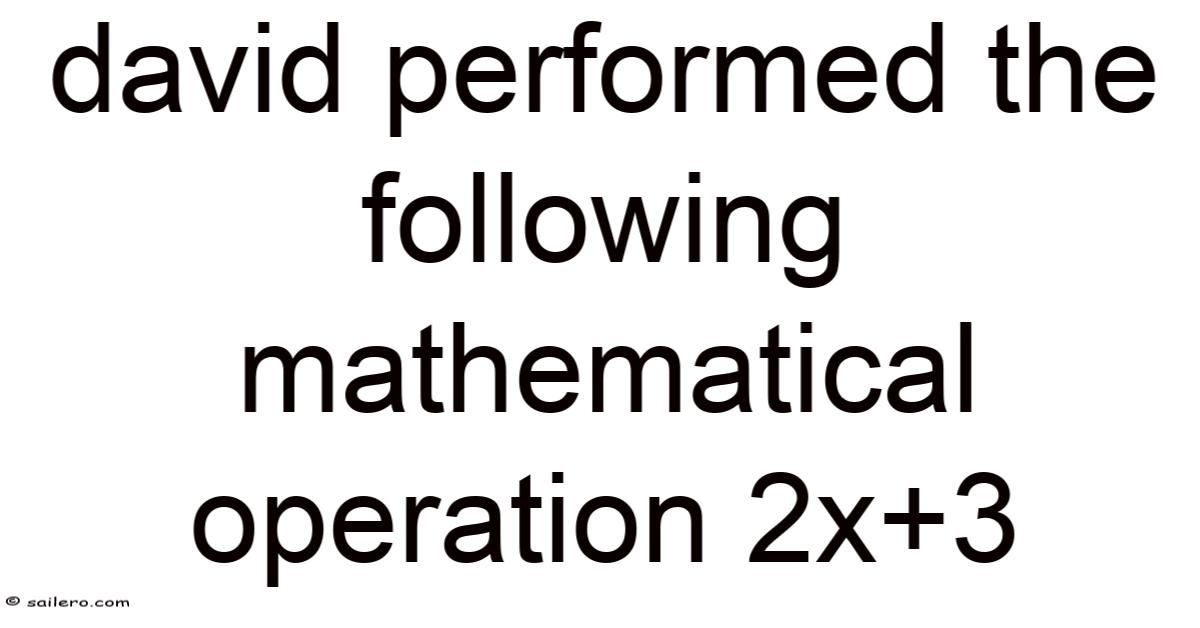
David Performed the Following Mathematical Operation: 2x + 3
When David encountered the algebraic expression 2x + 3, he was likely working on a problem that required isolating the variable x or evaluating the expression for a specific value. This simple linear expression is a cornerstone in algebra, representing a relationship where x is multiplied by 2 and then increased by 3. Understanding how to manipulate and solve equations involving this expression is critical for advancing in mathematics.
Breaking Down the Expression: 2x + 3
The expression 2x + 3 consists of three components:
- 2: The coefficient, which indicates how many times x is multiplied.
- Plus, x: The variable, representing an unknown value we aim to solve for. Practically speaking, 3. 3: The constant term, which remains unchanged.
It sounds simple, but the gap is usually here.
This expression can be part of an equation, such as 2x + 3 = 11, where the goal is to determine the value of x that satisfies the equation. Alternatively, it could represent a function, such as f(x) = 2x + 3, which maps input values to output values Practical, not theoretical..
Solving the Equation 2x + 3 = 11: Step-by-Step
Let’s assume David is solving the equation 2x + 3 = 11. Here’s how he would proceed:
Step 1: Subtract 3 from Both Sides
To isolate the term with x, subtract 3 from both sides of the equation:
2x + 3 - 3 = 11 - 3
2x = 8
This step uses the subtraction property of equality, which states that subtracting the same value from both sides maintains the balance of the equation.
Step 2: Divide Both Sides by 2
Next, divide both sides by the coefficient of x (which is 2) to solve for x:
2x / 2 = 8 / 2
x = 4
This step relies on the division property of equality, ensuring both sides remain equal after division.
Step 3: Verify the Solution
Substitute x = 4 back into the original equation to confirm the solution:
2(4) + 3 = 8 + 3 = 11
Since the left side equals the right side, x = 4 is correct.
Scientific Explanation: Why These Steps Work
The process of solving 2x + 3 = 11 is grounded in the principles of algebra. Because of that, the fundamental idea is to isolate the variable by performing inverse operations. Worth adding: addition and subtraction are inverses, as are multiplication and division. By applying these operations symmetrically to both sides of the equation, David ensures the equation remains balanced, adhering to the addition/subtraction and multiplication/division properties of equality.
Graphically, the expression 2x + 3 represents a straight line with a slope of 2 and a y-intercept at (0, 3). Solving the equation 2x + 3 = 11 corresponds to finding the x-coordinate where this line intersects the horizontal line y = 11. The intersection point (4, 11) visually confirms the solution x = 4.
Easier said than done, but still worth knowing.
Real-World Applications of 2x + 3
This expression is not just an abstract concept; it models real-world scenarios. - Distance Problems: A car traveling at 2 km/min with a 3 km head start covers 2x + 3 km in x minutes. Still, for instance:
- Cost Calculations: If a product costs $3 plus $2 per unit, the total cost for x units is 2x + 3. - Temperature Conversion: While not directly applicable, expressions like this form the basis for converting between scales.
Understanding how to manipulate such expressions helps in fields like engineering, economics, and physics, where relationships between variables are often linear.
Frequently Asked Questions (FAQ)
Q1: How do I solve 2x + 3 = 0?
Subtract 3 from both sides:
2x = -3
Divide by 2:
x = -1.5
Q2: What is the slope of the line y = 2x + 3?
The slope is 2, indicating the line rises 2 units for every 1 unit it moves to the right Most people skip this — try not to..
Q3: Can **2x +
Q3:What is the y-intercept of the line y = 2x + 3?
The y-intercept is the point where the line crosses the y-axis, which occurs when x = 0. Substituting x = 0 into the equation:
y = 2(0) + 3 = 3
Thus, the y-intercept is (0, 3). This value represents the starting point of the line on the graph and is a key feature in understanding its behavior But it adds up..
Conclusion
Solving equations like 2x + 3 = 11 is a fundamental skill in algebra that relies on logical steps and mathematical properties. By isolating the variable through inverse operations and verifying solutions, we ensure accuracy and consistency. Beyond the classroom, such equations model real-world relationships, from calculating costs to analyzing motion. The ability to interpret and manipulate linear expressions empowers problem-solving in diverse fields, highlighting the universality of mathematical principles. As we progress to more complex equations and functions, the foundation built here—balancing equations, understanding slopes, and applying properties of equality—will remain essential. Mastery of these concepts not only strengthens mathematical proficiency but also fosters critical thinking applicable to everyday challenges.
3 be simplified further?** No, 2x + 3 is already in its simplest form. Because 2x is a variable term and 3 is a constant, they are "unlike terms" and cannot be combined into a single term Simple, but easy to overlook. Less friction, more output..
Q4: How does the expression change if the 3 is subtracted instead of added?
If the expression were 2x - 3, the slope would remain the same (2), but the y-intercept would shift down to (0, -3). This would shift the entire line vertically downward on a coordinate plane.
Advanced Perspectives: Beyond the Basics
While 2x + 3 is a simple linear expression, it serves as the gateway to more complex algebraic concepts. As an example, if we were to square this expression—(2x + 3)²—we would move from a linear relationship to a quadratic one, resulting in the parabola 4x² + 12x + 9 It's one of those things that adds up..
Honestly, this part trips people up more than it should.
Beyond that, in the context of calculus, the derivative of the function $f(x) = 2x + 3$ is simply 2. This confirms that the rate of change is constant, which is the defining characteristic of all linear functions. Whether you are calculating the marginal cost of a product or the constant velocity of an object, the principles derived from this basic expression remain the same.
Conclusion
Solving equations like 2x + 3 = 11 is a fundamental skill in algebra that relies on logical steps and mathematical properties. Beyond the classroom, such equations model real-world relationships, from calculating costs to analyzing motion. But by isolating the variable through inverse operations and verifying solutions, we ensure accuracy and consistency. The ability to interpret and manipulate linear expressions empowers problem-solving in diverse fields, highlighting the universality of mathematical principles. That said, as we progress to more complex equations and functions, the foundation built here—balancing equations, understanding slopes, and applying properties of equality—will remain essential. Mastery of these concepts not only strengthens mathematical proficiency but also fosters critical thinking applicable to everyday challenges And that's really what it comes down to..
To deepen this understanding, consider how 2x + 3 can represent a real-world relationship. Take this: imagine a taxi service that charges a fixed starting fee of $3 plus $2 for every mile traveled. If x represents the number of miles, then the total cost can be modeled by:
[ C = 2x + 3 ]
If the total fare is $11, the equation becomes:
[ 2x + 3 = 11 ]
Solving gives:
[ 2x = 8 ]
[ x = 4 ]
So, the ride was 4 miles long. This example shows how the variable term represents the changing part of a situation, while the constant term represents the fixed starting value That's the part that actually makes a difference..
Common Mistakes to Avoid
When working with expressions like 2x + 3, several common errors often occur.
First, avoid combining unlike terms. The expression 2x + 3 cannot be simplified to 5x, because 2x contains a variable while 3 is a constant That's the part that actually makes a difference..
Second, when solving equations, remember that whatever operation you perform on one side must also be performed on the other side. To give you an idea, in the equation:
[ 2x + 3 = 11 ]
subtracting 3 from only the left side would make the equation unbalanced. The correct step is:
[ 2x + 3 - 3 = 11 - 3 ]
Third, distinguish between an expression and an equation. An expression, such as 2x + 3, represents a quantity. An equation, such as 2x + 3 = 11, states that two quantities are equal and can often be solved for a variable.
Visualizing the Expression
Graphing y = 2x + 3 helps connect algebra with geometry. The graph is a straight line with a slope of 2 and a y-intercept of 3. This means the line crosses the y-axis at:
