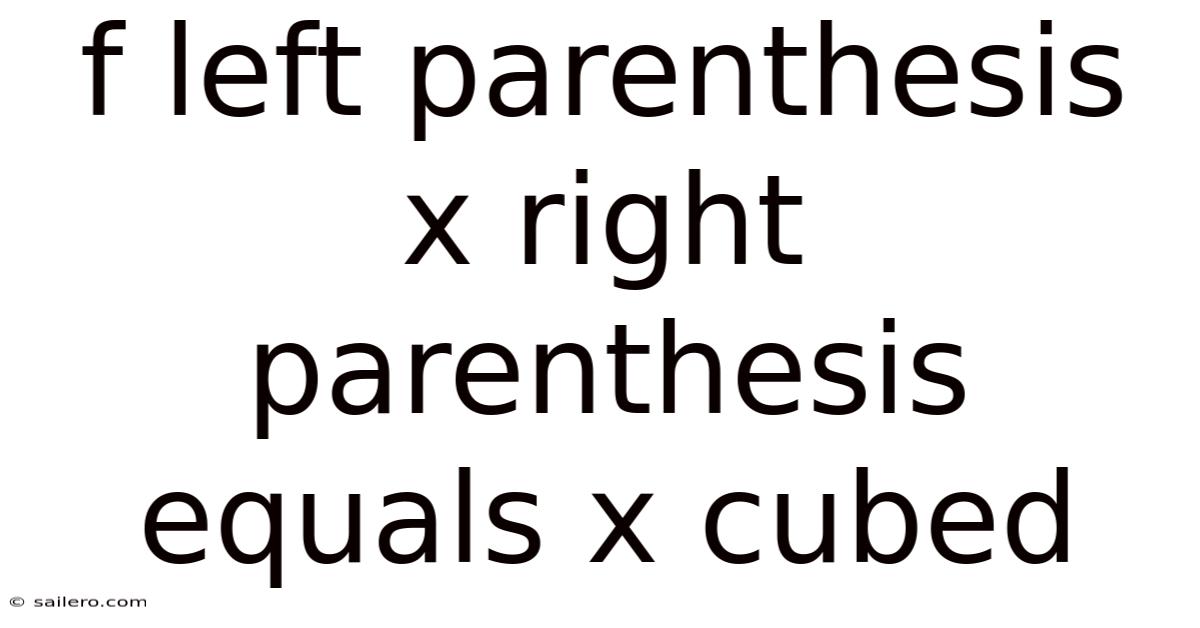
The cubic function, definedas f(x) = x³, is a fundamental building block in mathematics, representing a polynomial of degree three. This deceptively simple equation describes a curve that possesses unique geometric properties and widespread applications, making it essential for understanding more complex mathematical concepts and modeling real-world phenomena. Let's walk through its characteristics, significance, and practical uses Most people skip this — try not to. Still holds up..
Introduction to the Cubic Function
At its core, the function f(x) = x³ takes any real number input, x, and outputs its cube. And this means multiplying the input by itself twice more. Also, for example:
- If x = 2, then f(2) = 2³ = 2 * 2 * 2 = 8. * If x = -3, then f(-3) = (-3)³ = (-3) * (-3) * (-3) = -27.
- If x = 0, then f(0) = 0³ = 0.
The graph of y = x³ is a smooth, continuous curve that passes through the origin (0,0). It exhibits point symmetry with respect to the origin, meaning rotating the graph 180 degrees around (0,0) leaves it unchanged. This symmetry is a hallmark of odd functions, and x³ is a classic example It's one of those things that adds up..
Key Properties of the Cubic Function
- Domain and Range: The domain of f(x) = x³ is all real numbers (ℝ), and the range is also all real numbers (ℝ). Every real number is a cube of some real number (e.g., the cube root of any real number exists).
- Continuity and Differentiability: The function is continuous everywhere (no jumps or breaks) and differentiable everywhere (its derivative exists at every point). This makes it infinitely smooth.
- Monotonicity: The derivative of f(x) = x³ is f'(x) = 3x². Since 3x² is always non-negative (zero only at x=0), the function is strictly increasing on the entire real line. There are no local maxima or minima.
- Inflection Point: The second derivative is f''(x) = 6x. Setting this equal to zero gives x = 0. This point (0,0) is an inflection point, where the curve changes from concave down (for x<0) to concave up (for x>0). The tangent line at this point is horizontal (slope = 0).
- Odd Function: As covered, f(-x) = (-x)³ = -x³ = -f(x), confirming it's an odd function with rotational symmetry about the origin.
The Derivative: Understanding the Rate of Change
The derivative f'(x) = 3x² provides crucial insight into how the function behaves. It tells us the instantaneous rate of change of the function value with respect to x. * For x < 0: The derivative is also positive (3x² > 0), meaning the function is also increasing. And this indicates a horizontal tangent line at the origin, a point of zero slope. On the flip side, * For x > 0: The derivative is positive (3x² > 0), meaning the function is increasing. Crucially:
- At x=0: The derivative is zero (f'(0) = 3(0)² = 0). On the flip side, since the function is negative for negative x, "increasing" here means moving towards zero (becoming less negative) as x increases.
The Integral: Finding the Accumulated Change
The antiderivative (indefinite integral) of f(x) = x³ is F(x) = (1/4)x⁴ + C, where C is the constant of integration. This represents the accumulated area under the curve y = x³ from a starting point to x. The definite integral ∫ₐᵇ x³ dx = [ (1/4)x⁴ ]ₐᵇ = (1/4)b⁴ - (1/4)a⁴ calculates the net area between the curve and the x-axis from x = a to x = b The details matter here..
Applications of the Cubic Function
The simplicity and unique properties of x³ make it a vital tool across numerous fields:
- Geometry and Volume Calculations: The most direct application is calculating the volume of a cube. If the side length of a cube is s, its volume is V = s³. This extends to understanding scaling: doubling the side length of a cube increases its volume by a factor of 8 (2³ = 8). This principle applies to any 3D shape where dimensions scale proportionally.
- Physics and Motion: In kinematics, the equation for displacement under constant acceleration is s = ut + (1/2)at². While quadratic, understanding the cubic relationship is foundational for more complex motion analysis, like the motion of projectiles under air resistance or the relationship between kinetic energy and velocity (KE = (1/2)mv²).
- Economics and Modeling: Cubic functions can model relationships where the rate of change itself changes linearly. As an example, they might describe the diminishing returns in production as input increases, or the relationship between price and quantity demanded in certain market conditions.
- Computer Graphics and Animation: Cubic Bézier curves, defined by control points, are fundamental curves used to model smooth paths for objects in animation and vector graphics. While defined parametrically, the underlying mathematics relies on cubic polynomial equations.
- Engineering and Fluid Dynamics: The pressure drop in pipes or the flow rate through orifices can sometimes be modeled using cubic relationships, especially in turbulent flow regimes or specific hydraulic systems.
- Probability and Statistics: The cumulative distribution function (CDF) of a standard normal distribution involves an integral that includes a cubic term. Cubic splines are used for interpolation and smoothing data points in statistics and data analysis.
Why Understanding x³ Matters
Grasping the behavior of f(x) = x³ is not just an academic exercise. It provides a gateway to:
- Solving Equations: Many equations involve cubic terms (e.Here's the thing — g. , x³ - 8 = 0). Which means * Analyzing Graphs: Recognizing the shape and behavior of cubic graphs is crucial for interpreting data and models. * Foundation for Higher Math: Concepts like higher-degree polynomials, rational functions, and complex analysis build upon the principles established by linear and quadratic functions like x³.
- Practical Problem Solving: From calculating material needs for a cubic container to understanding scaling effects in physics, the cubic function is a practical tool.
Frequently Asked Questions (FAQ)
- Q: Is x³ always positive? No, it's positive for x > 0, negative for x < 0, and zero at x = 0.
- Q: What is the slope of y = x³ at x=0? The slope is zero (f'(0) = 0). The tangent line is horizontal.
- Q: Can x³ ever be negative? Yes, when x is negative (e.g., (-2)³ = -8).
- **Q: What is the inverse function of
A: The inverse function of f(x) = x³ is the cube root function, f⁻¹(x) = ∛x. This inverse is defined for all real numbers, meaning every real output of x³ corresponds to exactly one real input, a property not shared by all polynomial functions (like the quadratic). This one-to-one mapping makes the cubic function particularly straightforward to invert algebraically.
Conclusion
From the graceful arc of a Bézier curve in animation to the turbulent flow in a pipe, the humble cubic function f(x) = x³ serves as a critical mathematical bridge. We develop an intuitive understanding of change that is essential for navigating the complex, interconnected systems of the modern world. In real terms, it moves us beyond the simplicity of lines and parabolas into a realm where curvature changes direction, inflection points appear, and more nuanced relationships between variables can be modeled. Which means its applications are not confined to abstract theory but are embedded in the tools of engineers, the models of economists, and the algorithms of computer scientists. By mastering the behavior of x³—its symmetry, its derivatives, and its inverse—we gain more than just the ability to solve a specific type of equation. The cubic is a foundational pillar; to understand it is to equip oneself with a lens for seeing and shaping the nonlinear dynamics that define our reality.
