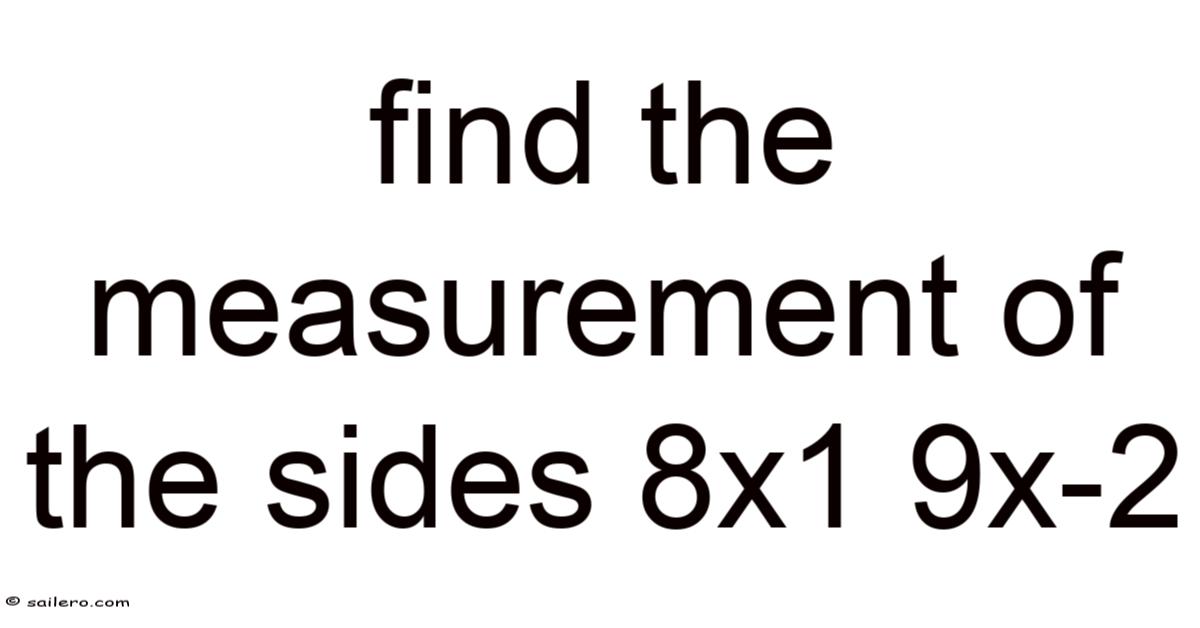
Find the Measurement of the Sides 8x+1 and 9x-2
When working with algebraic expressions in geometry, one common task is to determine the value of a variable that satisfies specific conditions. In this problem, we are given two expressions for the sides of a geometric figure: 8x + 1 and 9x - 2. Our goal is to find the measurement of these sides by solving for x. This type of problem is frequently encountered in algebra and geometry, particularly when dealing with isosceles triangles, rectangles, or other shapes where sides are represented by algebraic expressions.
Steps to Solve for the Measurement of the Sides
To find the measurement of the sides 8x + 1 and 9x - 2, follow these steps:
-
Identify the condition: Since the problem involves two expressions for sides, we assume they represent equal sides in a geometric figure. This is a common scenario in problems involving isosceles triangles or squares, where two sides are equal in length Still holds up..
-
Set up the equation: If the two sides are equal, we can set the expressions equal to each other: $ 8x + 1 = 9x - 2 $
-
Solve for x:
- Subtract 8x from both sides: $ 1 = x - 2 $
- Add 2 to both sides: $ x = 3 $
-
Substitute x back into the original expressions to find the measurement of the sides:
- For 8x + 1: $ 8(3) + 1 = 24 + 1 = 25 $
- For 9x - 2: $ 9(3) - 2 = 27 - 2 = 25 $
Thus, both sides measure 25 units when x = 3.
Scientific Explanation
The solution relies on the principle of equality in algebra. When two expressions are set equal to each other, solving for the variable x ensures that both sides of the equation represent the same value. In geometry, this concept is applied to figures where two sides must be equal, such as in an isosceles triangle (two equal sides) or a square (all sides equal) Nothing fancy..
The key idea is that algebraic equations can model real-world geometric relationships. By solving for x, we translate the abstract expressions into concrete measurements. This process is fundamental in fields like engineering, architecture, and physics, where precise calculations are essential Not complicated — just consistent..
Frequently Asked Questions (FAQ)
1. What if the problem involves a triangle with these sides?
If the expressions 8x + 1 and 9x - 2 represent two sides of a triangle, and the triangle is isosceles, then setting them equal is the correct approach. That said, if the problem involves a triangle with three sides (e.g., perimeter or area), additional information would be required That's the whole idea..
2. Can the sides be unequal?
If the problem does not specify that the sides are equal, we cannot assume they are. In such cases, we would need more context, such as a relationship between the sides (e.g., one side is twice as long as the other) or additional constraints like perimeter or area.
3. How do I verify my answer?
After solving for x, substitute the value back into both expressions to ensure they yield the same result. For this problem, substituting x = 3 gives 25 for both sides, confirming the solution is correct.
4. What units should I use?
The problem does not specify units, so the answer is in generic units. If the expressions represent lengths in meters, centimeters, or inches, the final measurement should include the appropriate unit.
5. What if the expressions are part of a different geometric figure?
To give you an idea, in a rectangle, opposite sides are equal. If 8x + 1 and 9x - 2 are opposite sides, setting them equal is valid. Still, in a scalene triangle, where all sides are different, this approach would not apply Small thing, real impact..
Conclusion
Finding the measurement of sides represented by algebraic expressions like 8x + 1 and 9x - 2 involves setting the expressions equal to each other and solving for the variable x. This method is rooted in the principles of equality and algebraic manipulation. By following the steps outlined above,
the correct side length is obtained, and the geometric figure is fully characterized The details matter here. No workaround needed..
In practice, this technique extends far beyond simple triangles or squares. On top of that, engineers use it to balance forces in trusses, architects to make sure load‑bearing walls meet at the correct angles, and physicists to solve for unknown distances in kinematic equations. The same principle—setting two expressions equal and solving for the unknown—remains a cornerstone of problem‑solving across disciplines.
Key Takeaway: Whenever you encounter two algebraic expressions that are meant to represent the same physical quantity—whether a side of a shape, a force, a voltage, or any other measurable attribute—equate them, isolate the variable, and verify the solution by substitution. This disciplined approach guarantees that the mathematical model accurately reflects the real‑world situation, providing both confidence in the result and a clear path for further analysis That's the part that actually makes a difference. Turns out it matters..
6. What if the figure is not a triangle?
The same algebraic strategy applies to any shape that imposes a relationship between two linear expressions. Take this case: consider a trapezoid whose non‑parallel sides are described by (5x-4) and (3x+7). If the trapezoid is isosceles, those two sides must be equal, so
[ 5x-4 = 3x+7 \quad\Longrightarrow\quad 2x = 11 \quad\Longrightarrow\quad x = \tfrac{11}{2}. ]
The resulting numerical value can then be used to compute the trapezoid’s height, area, or any other attribute that depends on the side lengths.
7. Dealing with multiple variables
Sometimes the expressions contain more than one unknown, such as (4x-2y) and (7x+3y-1). In these situations, a single equation is insufficient; a second relationship—perhaps a perimeter constraint or a ratio between (x) and (y)—is required. Once a system of equations is assembled, elimination or substitution techniques will yield the values of both variables Less friction, more output..
8. Common pitfalls to avoid
| Mistake | Why it matters | How to avoid it |
|---|---|---|
| Assuming all sides are equal without justification | Some figures are scalene or right‑angled, not equilateral | Verify the problem’s wording or use additional constraints |
| Forgetting to check the solution | A computational slip can lead to a wrong (x) that still satisfies the algebraic manipulation | Substitute back into the original expressions |
| Mixing units | Different units (cm vs. in) can produce inconsistent results | Keep all quantities in the same unit system until the final answer |
Honestly, this part trips people up more than it should Most people skip this — try not to..
9. Extending the idea to higher dimensions
In three‑dimensional geometry, the same principle applies to faces of a polyhedron. Take this: if two faces of a cube are described by linear expressions that must be equal because the cube’s faces are congruent, setting those expressions equal will give a relationship between the variables that define the cube’s edge length. Similarly, in physics, when balancing torques or forces, the expressions for each component are set equal to ensure equilibrium.
Final Thoughts
The act of equating two algebraic expressions to solve for an unknown is deceptively simple, yet it is a powerful tool that permeates every field that relies on quantitative reasoning. Whether you’re a geometry student determining the side of a triangle, an engineer calculating the dimensions of a beam, or a physicist deriving the distance traveled under uniform acceleration, the underlying strategy remains the same:
- Identify the relationship that forces the two expressions to be equal (equality of sides, forces, voltages, etc.).
- Set the expressions equal and rearrange to isolate the variable(s).
- Solve the resulting equation(s) using standard algebraic techniques.
- Verify by substituting the solution back into the original expressions.
- Interpret the numerical result in the context of the real‑world problem, ensuring consistency of units and physical feasibility.
By mastering this systematic approach, you not only solve the immediate problem but also build a dependable framework for tackling more complex, multi‑step challenges that will arise in advanced mathematics, engineering, and science. The elegance of this method lies in its universality: whenever two quantities are asserted to be the same, the algebraic equality that follows is the bridge between abstract symbols and concrete, measurable reality.
