Mastering Spanish Listening Comprehension: Identifying Infinitives from Conjugated Verbs
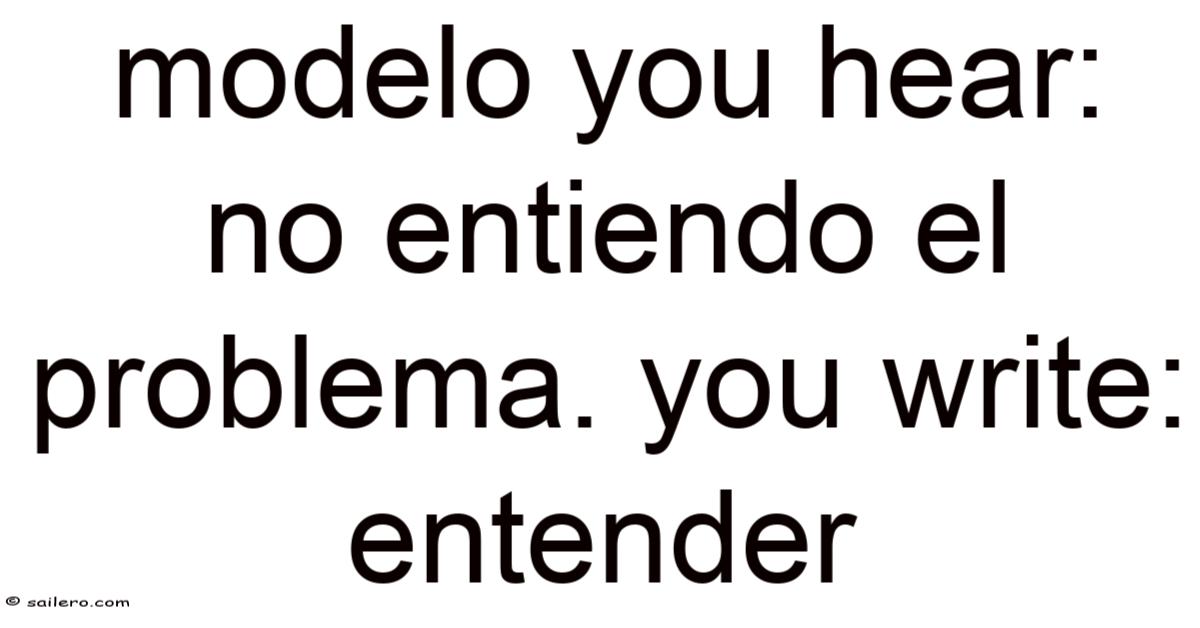
One of the most fundamental skills in acquiring Spanish fluency is the ability to bridge the gap between what you hear—conjugated verbs in rapid speech—and the foundational dictionary form: the infinitive. Think about it: ** This seemingly simple task actually tests a complex chain of cognitive processes: auditory discrimination, morphological analysis, and vocabulary retrieval. On the flip side, a classic exercise found in many language curriculums presents a modelo (model) where the learner hears a complete sentence and must write the infinitive of the conjugated verb they identified. On the flip side, for instance, the prompt might state: **Modelo: You hear: no entiendo el problema. That said, you write: entender. Mastering this specific exercise type is a gateway to higher-level listening proficiency and grammatical accuracy.
Understanding the Exercise Mechanics
Before diving into strategies, it is crucial to understand exactly what this exercise demands. The audio input provides a conjugated verb form embedded in a sentence. The required output is the infinitivo (infinitive)—the non-conjugated form ending in -ar, -er, or -ir found in dictionaries.
In the example no entiendo el problema, the conjugated verb is entiendo (first-person singular, present indicative of entender). The stem change (e → ie) and the ending -o mask the root infinitive entender. The learner must reverse-engineer the conjugation: recognize the ending -o indicates yo (I), identify the stem change pattern, and retrieve the base verb entender.
This "reverse conjugation" skill is vital because real-world listening does not present verbs in their dictionary forms. Still, if you only know infinitives, you will hear noise; if you only know conjugations, you cannot look up new words efficiently. Native speakers speak in fully conjugated sentences. This exercise forces the brain to build a rapid, bidirectional highway between the two forms.
The Three Conjugation Families: Your Structural Anchors
Spanish verbs fall into three categories based on their infinitive endings. Recognizing these families instantly narrows down the possibilities when you hear a conjugated verb.
1. -AR Verbs (The Largest Group)
These verbs follow the most predictable patterns Worth keeping that in mind..
- Infinitive: Hablar (to speak), Estudiar (to study), Escuchar (to listen).
- Present Tense Yo Form: Hablo, Estudio, Escucho (Ends in -o).
- Key Listening Cue: Listen for the vowel 'a' in the stem (e.g., habl-, estudi-, escuch-) before the ending.
2. -ER Verbs
- Infinitive: Comer (to eat), Beber (to drink), Leer (to read).
- Present Tense Yo Form: Como, Bebo, Leo (Ends in -o).
- Key Listening Cue: The stem vowel is 'e' (or 'i' in leer/ver types). The endings shift from -ar vowels to -e vowels (-o, -es, -e, -emos, -éis, -en).
3. -IR Verbs
- Infinitive: Vivir (to live), Escribir (to write), Abrir (to open).
- Present Tense Yo Form: Vivo, Escribo, Abro (Ends in -o).
- Key Listening Cue: Similar to -ER verbs in singular forms, but distinct in the nosotros (-imos) and vosotros (-ís) forms.
Why this matters for the exercise: If you hear no compro el pan, the -o ending tells you it is yo. The stem compr- strongly signals an -AR verb. You hypothesize comprar. If you hear no vendo el coche, the stem vend- with an e suggests -ER or -IR. The infinitive is vender.
The "Stem-Changing" Trap: Boot Verbs
The example entiendo (from entender) introduces the most common stumbling block: stem-changing verbs (often called "boot verbs" or "shoe verbs"). In the present tense, the stem vowel changes in all forms except nosotros and vosotros.
There are four main types of stem changes. Recognizing the result of the change in the audio helps you reconstruct the original infinitive vowel Simple, but easy to overlook..
| Change Type | Infinitive Vowel | Changed Vowel (in boot) | Example Infinitive | Example Yo Form (Heard) | Strategy |
|---|---|---|---|---|---|
| E → IE | E | IE | Entender, Querer, Pensar, Preferir | Entiendo, Quiero, Pienso, Prefiero | Hear IE → Write E |
| O → UE | O | UE | Poder, Dormir, Volver, Costar | Puedo, Duermo, Vuelvo, Cuesto | Hear UE → Write O |
| E → I | E | I | Pedir, Servir, Repetir, Seguir | Pido, Sirvo, Repito, Sigo | Hear I (stressed) → Write E |
| U → UE | U | UE | Jugar (only common one) | Juego | Hear UE → Write U |
Practical Application: If the audio says: ¿Prefieres café o té?
- Identify verb: Prefieres (tú form).
- Spot stem change: Prefer- → Prefier- (E → IE).
- Reverse engineer: Change ie back to e → Prefer-.
- Add infinitive ending based on conjugation family (-er for prefieres) → Preferir.
Irregular Yo Forms: The "Go" Verbs and Beyond
High-frequency verbs often have irregular yo forms that obscure the infinitive entirely. Since listening exercises frequently use the yo form (statements like "I do this," "I see that"), you must memorize these specific mappings Easy to understand, harder to ignore..
| Infinitive | Yo Form (Heard) | Key Transformation |
|---|---|---|
| Tener | Tengo | Stem change (e→ie) + -go ending |
| Venir | Vengo | Stem change (e→ie) + -go ending |
| Poner | Pongo | -go ending |
| Salir | Salgo | -go ending |
| Hacer | Hago | -go ending (c→g) |
| Saber | Sé | Total irregularity |
| Ver | Veo | Regular -er ending but stem 'v' |
| Dar | Doy | -oy ending |
| Estar | Estoy | -oy ending |
| Ir | Voy | Total irregularity |
| Ser | Soy | Total irregularity |
Drill Strategy: Create flashcards with the Yo
Drill Strategy: Create flashcards with the Yo form on the front and the infinitive on the back. Drill them until the mapping is instantaneous—hearing tengo must trigger tener without a conscious "reverse-engineering" step Less friction, more output..
The Preterite Minefield: Radical Changes and "Strong" Verbs
While the present tense relies on stem-changing patterns (the "boot"), the preterite tense introduces radical stem changes that affect the entire conjugation for specific verb groups. Crucially, -AR and -ER verbs that stem-change in the present (E→IE, O→UE) do NOT stem-change in the preterite. Only -IR verbs carry stem changes into the past, and they mutate differently (E→I, O→U) That's the whole idea..
Even so, the biggest listening traps are the "Strong Preterites" (verbos fuertes). These verbs undergo a complete stem overhaul and share a unique set of unstressed endings (-e, -iste, -o, -imos, -isteis, -ieron/-eron). Because the endings sound similar, the stem is the only identifier The details matter here..
| Infinitive | Preterite Stem | Yo Form (Heard) | Él/Ella Form (Heard) | Listening Key |
|---|---|---|---|---|
| Estar / Andar | estuv- / anduv- | Estuve / Anduve | Estuvo / Anduvo | Listen for uv + stress on ú (yo) vs o (él) |
| Tener / Venir | tuv- / vin- | Tuve / Vine | Tuvo / Vino | Tuv-/Vin- + o ending (él) sounds like present yo of other verbs! |
| Poder / Poner | pud- / pus- | Pude / Puse | Pudo / Puso | D/S stem consonant shift |
| Saber / Haber | sup- / hub- | Supe / Hube | Supo / Hubo | P/B stem shift |
| Hacer | hic- (→ hiz- 3rd pers) | Hice | Hizo | C/Z spelling change preserves sound /θ/ or /s/ |
| Querer / Venir | quis- / vin- | Quise / Vine | Quiso / Vino | S stem marker |
| Decir / Traer | dij- / traj- | Dije / Traje | Dijo / Trajo | J (/x/ sound) stem marker |
Critical Auditory Discrimination:
- Tuvo (Preterite tener) vs. Tuvo (Imperfect tener — rare, usually tenía) vs. Tubo (Noun: pipe/tube). Context is king.
- Supo (Preterite saber: "found out") vs. Sabía (Imperfect saber: "knew").
- Hizo (Preterite hacer) vs. Hacía (Imperfect hacer). The /θ/ or /s/ vs /ɾ/ (flap) distinction in the middle consonant is your anchor.
Imperfect vs. Preterite: The Aspect Signal
In listening exams, distinguishing Comía (Imperfect) from Comió (Preterite) is often the difference between a right and wrong answer. Train your ear to the rhythm and vowel quality:
- The Penultimate Stress (Imperfect): Co-mí-a, Co-mí-a-mos, Co-mí-an. The stress always falls on the í (or aba for -AR). It creates a "swinging" rhythm: da-DA-da.
- The Final Stress (Preterite Yo/Él): Co-MÍ, Co-mi-Ó. The stress hits the last syllable (monosyllabic yo form) or the final vowel (él form). It feels "final," "punctual."
- The Nosotros Anchor: Comimos is identical in Present and Preterite for -AR/-IR verbs. You must rely on context clues (time markers like ayer vs. todos los días) to time-travel correctly.
Subjunctive Triggers: Hearing the "Mood" Shift
Advanced listening requires detecting the subjunctive not just by conjugation, but by the trigger phrase that precedes it. The subjunctive often sounds "softer" or "shorter" due to vowel raising (-AR → -e, -ER/-IR → -a) That's the part that actually makes a difference..
The "WEIRDO" Audio Scan: When you hear these structures, switch your parsing engine to "Subjunctive Mode": *
- Wishing: Quiero que vengas (I want you to come)
- Emotions: Me alegra que estudies (I'm glad you're studying)
- If/When: Si tuviera dinero, viajaría (If I had money, I would travel)
- Refusal/Doubt: Dudo que él venga (I doubt that he's coming)
- Desire/Necessity: Necesito que leas esto (I need you to read this)
- Other subjunctive expressions: Antes de que parta (Before he leaves)
Pro Tip: The subjunctive often sounds "tense-less" or "mood-less" compared to the indicative. Your ear should detect a subtle lift in pitch and a shortening of vowels, especially in the tú form: vengas vs. viene Simple as that..
The Listening Pyramid: Building Your Strategy
Mastering Spanish listening isn't just about recognizing words—it's about constructing a mental framework that processes multiple grammatical signals simultaneously. Here's how to build your listening pyramid:
- Foundation Level (Sounds & Rhythm): Start with isolated verb forms. Practice the uv/o distinction until it's automatic. Train your ear to the "swing" of imperfect stress versus the "stab" of preterite stress.
- Structure Level (Grammar Patterns): Connect sounds to meaning. When you hear haya or haya in a question like ¿Es posible que haya problema? you instantly know subjunctive is present.
- Context Level (Real Communication): This is where champions are made. Native speakers don't speak in textbook sentences. They blend tenses, interrupt themselves, and use fillers. Your job is to extract the grammatical gold from the noise.
Final Drill: Listen to a Spanish news report. Identify one preterite action, one imperfect description, and one subjunctive wish. You'll start hearing the layers of meaning that make Spanish both challenging and beautiful.
Conclusion: Your Ears Are Your Time Machine
Spanish listening fluency is not a destination but a journey of increasingly refined perception. Here's the thing — remember, every native speaker has been training their ear since birth, but you have the advantage of conscious analysis. By mastering the subtle auditory cues—the uv versus o, the stress shift from comía to comió, the "softened" quality of the subjunctive—you open up the ability to travel through time and mood with every spoken sentence. Use it. Practice these discriminations daily, and soon you won't just hear Spanish—you'll understand the heartbeat of its speakers, feeling the difference between what was done, what was ongoing, and what might be Worth keeping that in mind..
