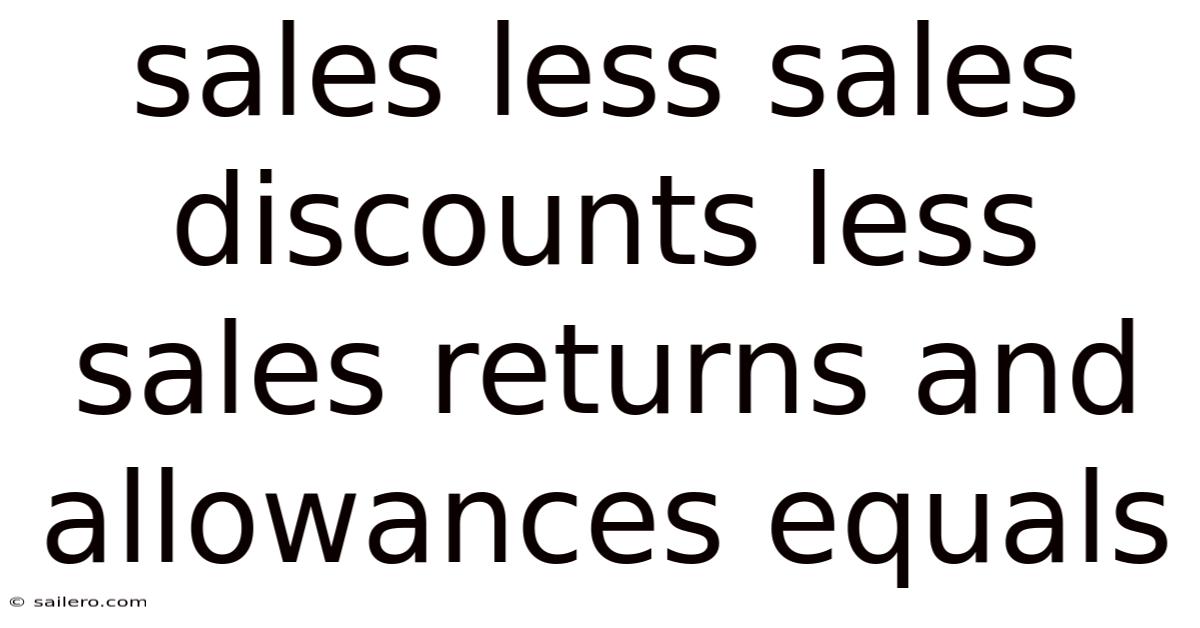
The foundational equation governing revenuerecognition in accounting is Sales - Sales Discounts - Sales Returns and Allowances = Net Sales. Understanding this process is crucial for accurate financial reporting, informed decision-making, and assessing a company's core operational performance. This simple formula encapsulates the journey of gross sales revenue through deductions to arrive at the actual cash inflow a business recognizes from its primary sales activities. This article gets into each component of this essential equation, explaining its significance, application, and the critical role it plays in financial statements.
Introduction
Every business transaction involving the sale of goods or services generates revenue. Even so, not all sales revenue remains pure; various adjustments are necessary to reflect the true economic value recognized by the company. Even so, the equation Sales - Sales Discounts - Sales Returns and Allowances = Net Sales serves as the bedrock for calculating this final figure. Net Sales represents the actual revenue a company earns after accounting for reductions like early payment discounts, customer-initiated returns of defective or unsatisfactory goods, and allowances granted for damaged items or pricing errors. Day to day, this metric is a vital indicator of a company's core sales effectiveness and is reported on the income statement as a key line item. Mastering this concept is fundamental for accountants, business owners, investors, and anyone analyzing a company's financial health. It transforms raw sales figures into a more realistic picture of the revenue generated from ongoing operations Small thing, real impact..
The Core Equation: Breaking Down Net Sales
The equation is straightforward but its components require careful understanding:
- Sales (Gross Sales): This represents the total revenue recognized from all sales transactions before any deductions. It's the "top line" figure. To give you an idea, if a store sells 100 units of a product at $10 each, Gross Sales = $1,000.
- Sales Discounts: These are reductions in the selling price offered to customers, typically as an incentive for early payment. Common examples include a 1% discount if payment is made within 10 days instead of the standard 30-day terms. Sales Discounts are recorded as a contra-revenue account, reducing Gross Sales. If a customer buys $1,000 worth of goods and takes a 2% early payment discount, the Sales Discount recorded is $20. Thus, the Net Sales calculation begins by subtracting this $20 from the Gross Sales.
- Sales Returns and Allowances: This category encompasses two distinct but related concepts:
- Sales Returns: This involves the physical return of merchandise by the customer to the seller. The customer receives a refund for the returned item(s). The original sale is reversed, and the revenue is removed. Take this: if a customer returns $500 worth of goods that were previously sold, a Sales Return of $500 is recorded.
- Sales Allowances: This refers to a reduction in the selling price granted to a customer without the physical return of the merchandise. Common reasons include damaged goods (where the seller agrees to sell at a lower price instead of returning), pricing errors, or minor defects. The allowance reduces the revenue recognized. Here's one way to look at it: if a customer is sold a $1,000 item but receives a $100 allowance due to a minor scratch, the Sales Allowance recorded is $100.
Applying the Equation: A Step-by-Step Example
Consider a small retail business, "TechGadgets Inc." for a single month:
- Gross Sales: TechGadgets Inc. sells 500 smartphones at an average price of $800 each. Gross Sales = 500 units x $800 = $400,000.
- Sales Discounts: During the month, 20 customers take advantage of an early payment discount. Their total purchases amounted to $80,000. TechGadgets Inc. grants a 2% discount for prompt payment. Sales Discounts = $80,000 x 2% = $1,600.
- Sales Returns: Two customers returned damaged smartphones totaling $2,000. Sales Returns = $2,000.
- Sales Allowances: Three customers received allowances for minor scratches or pricing errors totaling $1,500. Sales Allowances = $1,500.
- Calculating Net Sales: Applying the core equation:
- Net Sales = Gross Sales - Sales Discounts - Sales Returns and Allowances
- Net Sales = $400,000 - $1,600 - ($2,000 + $1,500)
- Net Sales = $400,000 - $1,600 - $3,500
- Net Sales = $395,900
That's why, TechGadgets Inc.'s reported Net Sales for the month is $395,900 And that's really what it comes down to..
Scientific Explanation: Why These Deductions Matter
The deductions captured by Sales Discounts, Sales Returns, and Sales Allowances are not merely administrative expenses; they represent critical adjustments to align the recorded revenue with the actual cash received and the value of goods delivered to the customer. Here's the rationale:
- Sales Discounts: These are a cost of doing business. Offering discounts is a strategic marketing tool to accelerate cash flow and improve liquidity. By recording the discount against revenue, the income statement accurately reflects the net cash inflow generated by the core sales activity. It prevents the overstatement of revenue from artificially inflated gross sales figures.
- Sales Returns: When a customer returns goods, the company no longer possesses those goods and cannot resell them. The original revenue recorded upon the initial sale must be reversed to avoid inflating earnings with revenue from goods that were ultimately not sold to the end customer. This ensures the income statement reflects the true revenue generated from goods successfully delivered and retained by customers.
- Sales Allowances: Similar to returns, an allowance represents a reduction in the value of the sale. The company has provided goods of lesser value (due to damage or error) and must recognize a corresponding reduction in revenue. Recording the allowance prevents overstating revenue for goods that were effectively sold at a lower net price than initially recorded. It captures the true economic value transferred to the customer.
These deductions are fundamental to the matching principle of accounting. Revenue is recognized when earned (when goods are delivered or services performed), and expenses (like discounts given and costs associated with processing returns) are recognized when incurred. Net Sales is the figure that best matches the revenue earned from core operations with the costs associated with facilitating those sales.
Frequently Asked Questions (FAQ)
Frequently Asked Questions (FAQ)
| Question | Answer |
|---|---|
| **What is the difference between Sales Discounts and Cash Discounts?Here's the thing — ** | Sales Discounts are recorded on the income statement as a reduction to revenue. Cash Discounts refer to the actual cash savings a customer enjoys; they are the same transaction, just viewed from the customer’s perspective. |
| **Do sales returns affect inventory levels?That said, ** | Yes. Also, when a return is accepted, the returned goods are typically added back to inventory, and the cost of those goods may be recorded as a cost‑of‑goods‑sold adjustment or as a separate return‑related expense, depending on the company’s accounting policy. And |
| **Can sales allowances be recorded as a separate line item on the balance sheet? ** | No. Still, sales allowances are an income‑statement adjustment. Day to day, they reduce revenue and are shown either as a separate line in the “Other” section of the income statement or directly under “Sales Allowances” if the company prefers that presentation. |
| How do these adjustments affect gross margin? | Gross margin is calculated as Gross Sales – Cost of Goods Sold. Net sales adjustments (discounts, returns, allowances) do not directly alter gross margin; they affect operating income and net profit. Even so, if returns or allowances are large, they can indirectly influence gross margin by prompting changes in inventory management or pricing strategies. |
| What happens if a company doesn’t record these deductions? | Omitting these adjustments can lead to overstated revenue, misleading financial ratios, and potential violations of accounting standards. Auditors will flag such omissions, and the company may face restatements or regulatory penalties. |
Putting It All Together
When you look at a company’s income statement, the headline figure—Net Sales—is the most trustworthy indicator of the true volume of revenue that has actually been earned and retained. The process of subtracting sales discounts, returns, and allowances from gross sales is not a mere formality; it is a reflection of the economic reality of each transaction.
By honoring the matching principle, we check that the revenue recognized in a given period is paired with the costs and adjustments that directly relate to that revenue. This leads to more accurate earnings, better comparability across periods, and greater confidence for investors, creditors, and internal stakeholders.
Conclusion
Net sales are more than a number on a financial statement; they are a distilled measure of a company’s core operating performance. Understanding the nuances of sales discounts, returns, and allowances—and how they shape the final figure—provides deeper insight into a firm’s pricing strategy, customer satisfaction, and cash‑flow dynamics.
Short version: it depends. Long version — keep reading.
For analysts, managers, and investors alike, the ability to dissect the net sales line and appreciate the adjustments that bring us from gross to net is essential. It signals disciplined accounting, transparency in reporting, and a commitment to presenting the financial truth. As you review future statements, keep an eye on these adjustments: they often tell the story that the headline figure alone cannot.
