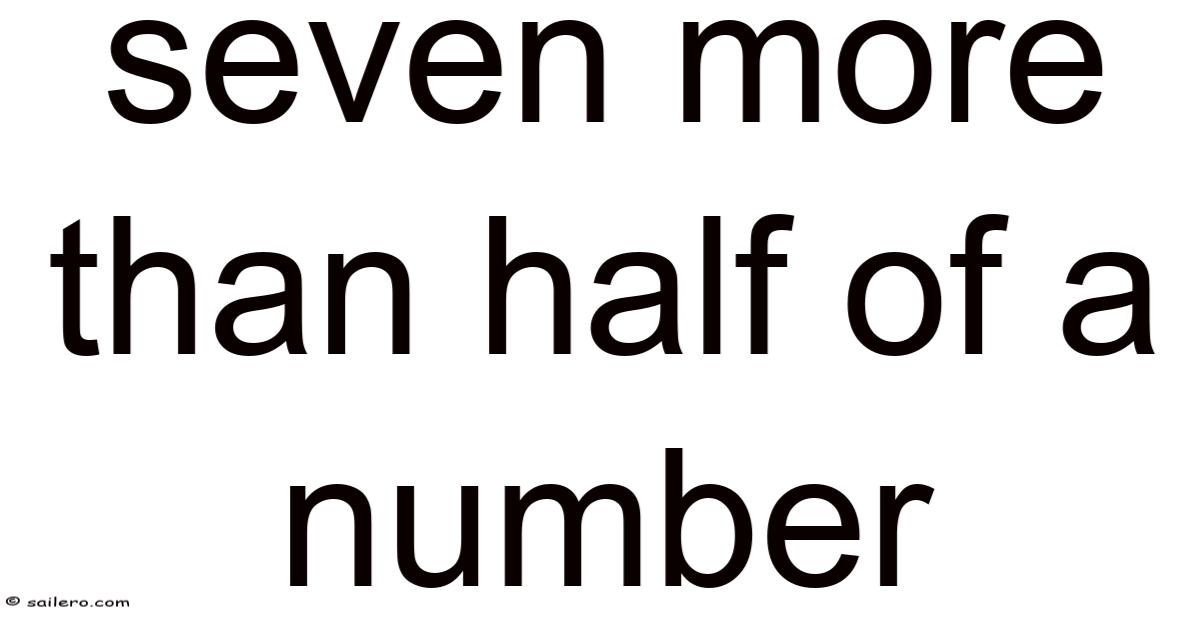
Understanding the concept of seven more than half a number is a fundamental mathematical idea that often surprises learners at first. Practically speaking, this topic might seem simple at first glance, but it holds significant importance in various real-life scenarios, from basic arithmetic to advanced problem-solving. In this article, we will look at the meaning behind this expression, explore its applications, and provide practical examples to solidify your understanding.
This is the bit that actually matters in practice.
When we talk about seven more than half a number, we are referring to a mathematical operation that combines two components: a fraction and an integer. The phrase “seven more” indicates that we are adding a specific value to half of a certain number. Practically speaking, this concept is essential in understanding how to manipulate numbers and solve problems that require such calculations. By breaking it down, we can see how this idea applies in everyday situations and academic contexts That's the part that actually makes a difference..
To begin with, let’s clarify the components of the expression. Also, Half of a number is simply that number divided by two. Now, when we add seven more to this half, we are essentially calculating 5 plus 7. That's why this results in 12. Consider this: for example, if we take the number 10, half of it would be 5. This simple calculation illustrates the core idea behind the expression.
This is the bit that actually matters in practice It's one of those things that adds up..
Even so, the importance of this concept goes beyond just arithmetic. It matters a lot in various fields such as finance, science, and even daily decision-making. On the flip side, imagine you are managing a budget, and you need to calculate expenses. If your total expenses are half of your monthly income, and you want to add an additional amount, understanding this concept helps in planning your finances effectively That's the part that actually makes a difference..
In educational settings, grasping this concept is vital for students who are learning to perform operations with fractions and whole numbers. It builds a strong foundation for more complex mathematical topics, such as algebra and calculus. By mastering this idea, learners can tackle problems with confidence and accuracy.
Let’s explore the steps involved in calculating seven more than half a number. Now, we add seven to this half. That said, this gives us 7. In practice, half of 15 is 7. 5. First, we identify the number we are working with. Suppose we choose a number, say 15. 5 + 7, which equals 14.On top of that, 5. This example demonstrates how the process unfolds.
But why is this important? Understanding how to work with fractions and integers is essential for solving real-world problems. Take this case: in cooking, recipes often require adjusting quantities. If a recipe calls for half a cup of an ingredient and you need to add an extra amount, knowing how to perform such calculations becomes invaluable Simple, but easy to overlook..
At its core, the bit that actually matters in practice.
On top of that, this concept extends to scientific calculations. On top of that, in experiments, scientists might need to measure quantities that are fractions of a unit. Think about it: by understanding how to combine these fractions with whole numbers, they can ensure precision in their results. This skill is particularly useful in fields like chemistry and physics, where accuracy is key Small thing, real impact..
Not the most exciting part, but easily the most useful Easy to understand, harder to ignore..
Now, let’s examine some common scenarios where this idea comes into play. Consider a student preparing for a math test. They might encounter questions that require them to solve equations involving fractions. That said, for example, if a student knows that seven more than half of 20 equals a certain value, they can easily compute it. Breaking it down, half of 20 is 10, and adding seven gives 17. This not only reinforces their understanding but also builds confidence in their mathematical abilities.
Another interesting aspect is how this concept applies to problem-solving. Imagine a situation where you are planning a trip and need to calculate the total cost. If the cost of a single ticket is half of your budget, and you add an extra amount, you must use this formula to determine your final expense. This practical application highlights the relevance of this mathematical idea in daily life Most people skip this — try not to. Took long enough..
In addition to practical uses, scientific literacy is enhanced by understanding such concepts. But when reading about data or statistics, recognizing the structure of numbers helps in interpreting information accurately. Take this: if a report states that seven more than half of a population is involved in a certain activity, it prompts a deeper analysis of the data Nothing fancy..
It is also important to note that this concept can be applied in everyday conversations. When discussing finances with friends or family, being able to explain this idea clearly can lead to better communication. To give you an idea, if someone says they need seven more than half of their savings, it opens the door for a productive discussion about budgeting Less friction, more output..
As we explore further, it becomes clear that mastering this concept is not just about numbers; it’s about developing a logical mindset. This skill is transferable across various disciplines, making it a valuable asset for anyone looking to enhance their learning journey.
To wrap this up, seven more than half a number is more than just a mathematical formula. It represents a way of thinking that can be applied in numerous aspects of life. By understanding this concept thoroughly, learners can figure out complex problems with ease and gain a deeper appreciation for the beauty of mathematics. Whether in school, work, or personal life, this knowledge empowers individuals to make informed decisions and solve challenges effectively.
This is where a lot of people lose the thread Worth keeping that in mind..
Remember, the journey of learning is ongoing. Also, each time you encounter this idea, you are strengthening your mathematical foundation. Embrace this process, and let it inspire you to explore more about the fascinating world of numbers.
, or even in cooking measurements. Because of that, for instance, if a recipe calls for seven more than half of a cup of flour, a chef must first determine half of the standard measurement and then adjust accordingly. Such scenarios demonstrate how foundational mathematical principles quietly underpin everyday decision-making The details matter here..
Educators often highlight this concept because it bridges abstract arithmetic with tangible outcomes. Because of that, in classrooms, teachers might use visual aids like pie charts or bar models to illustrate how splitting quantities and adding incremental values work. This hands-on approach helps students internalize the logic, making it easier for them to tackle more complex operations later, such as algebraic expressions or ratio comparisons.
Worth adding, the ability to dissect and manipulate numerical relationships sharpens critical thinking skills. When faced with a problem—whether calculating discounts during a sale, estimating travel times, or analyzing trends in social sciences—the mind trained in these basics can approach challenges with clarity and precision. It’s a small but powerful tool in the cognitive toolkit Not complicated — just consistent. Simple as that..
Interestingly, this concept also surfaces in creative fields. Artists and designers often use proportional reasoning, which relies on understanding halves, thirds, and incremental adjustments. A graphic designer laying out a page might allocate half the space for text and then add seven additional units for margin, ensuring balance and readability Small thing, real impact..
Historically, the roots of such mathematical reasoning trace back to ancient civilizations. Day to day, the Egyptians and Babylonians used fractions extensively in construction and astronomy, while Greek philosophers like Euclid formalized many of these ideas into systematic methods. Today, these time-tested principles remain relevant, proving that mathematics is not just a subject studied in isolation but a universal language that transcends eras.
Not obvious, but once you see it — you'll see it everywhere.
So, to summarize, the idea of seven more than half a number is a humble yet profound concept that resonates far beyond the classroom. It serves as a gateway to logical reasoning, a cornerstone for problem-solving, and a lens through which we interpret the world. By mastering such fundamentals, individuals equip themselves with the confidence and tools to work through both routine tasks and involved challenges. Consider this: whether budgeting, designing, or decoding data, this knowledge quietly empowers us to think critically and act decisively. Embrace these basics, and you lay the groundwork for lifelong learning and curiosity Still holds up..
Counterintuitive, but true.
