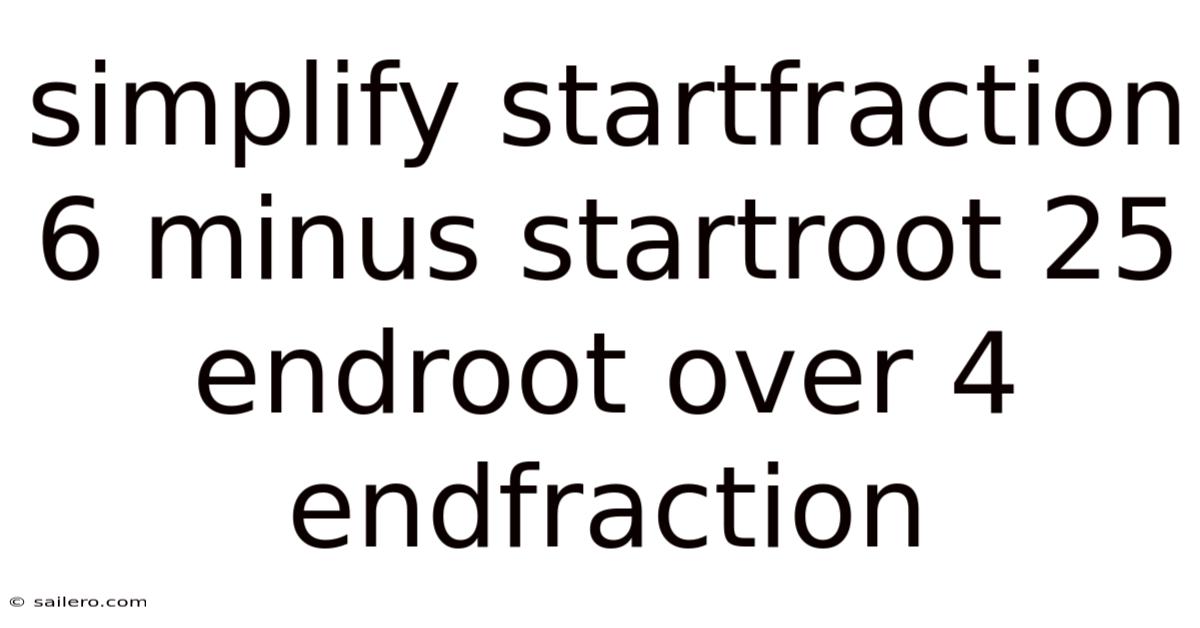
Simplify Startfraction 6 minus Startroot 25 Endroot Over 4 Endfraction
When faced with a mathematical expression like simplify startfraction 6 minus startroot 25 endroot over 4 endfraction, the goal is to reduce it to its simplest form. This process involves understanding the components of the fraction, applying mathematical rules, and ensuring clarity in the final result. Practically speaking, the expression in question is (6 - √25)/4. At first glance, it may seem complex due to the square root, but breaking it down step by step reveals a straightforward solution.
Steps to Simplify the Expression
The first step in simplifying simplify startfraction 6 minus startroot 25 endroot over 4 endfraction is to evaluate the square root in the numerator. Even so, the term √25 refers to the principal square root of 25, which is a perfect square. Since 5 × 5 equals 25, √25 simplifies to 5. This substitution transforms the numerator from 6 - √25 to 6 - 5.
Next, perform the subtraction in the numerator: 6 - 5 equals 1. This reduces the entire fraction to
This reduces the entire fraction to ( \frac{1}{4} ). In real terms, since 1 and 4 share no common factors other than 1, the expression is now in its simplest form. So simplifying mathematical expressions like this is essential for clarity and efficiency in problem-solving, laying the groundwork for more advanced algebraic concepts. By breaking down complex components and applying foundational rules, even seemingly layered expressions can be resolved with precision and ease.
Continuation of theArticle
The simplicity of the result, ( \frac{1}{4} ), underscores a fundamental principle in mathematics: breaking down complex expressions into smaller, manageable steps often reveals clarity where confusion initially resides. This example illustrates how recognizing perfect squares and applying basic arithmetic operations can transform an intimidating expression into an intuitive solution. Such simplification is not merely an academic exercise; it is a critical skill that enhances problem-solving efficiency in diverse mathematical contexts, from algebra to calculus.
Not obvious, but once you see it — you'll see it everywhere.
To give you an idea, simplifying radicals or fractions is a recurring theme in higher-level mathematics. And in this case, the process reinforced the importance of methodical thinking—evaluating each component systematically rather than attempting to tackle the entire expression at once. Worth adding: whether solving equations, optimizing functions, or analyzing data, the ability to reduce expressions to their simplest form streamlines analysis and minimizes errors. This approach is universally applicable, whether dealing with numerical values or algebraic terms Practical, not theoretical..
It sounds simple, but the gap is usually here.
Also worth noting, mastering such simplifications builds a foundation for understanding more abstract concepts. As an example, simplifying ( \sqrt{25} ) to 5 is a stepping stone to grasping properties of exponents, irrational numbers, or even complex numbers. It trains the mind to identify patterns and apply rules consistently, skills that are indispensable in advanced mathematical reasoning.
Conclusion
The expression simplify startfraction 6 minus startroot 25 endroot over 4 endfraction may appear daunting at first, but its resolution through
This process highlights the elegance of mathematical thinking, where each step builds upon the previous one to reveal a clear and concise solution. By carefully examining roots and simplifying fractions, we not only arrive at the answer but also deepen our understanding of the underlying principles. Such exercises reinforce the value of patience and precision, reminding us that clarity often emerges from methodical analysis.
In practical terms, this skill extends beyond theoretical exercises—it empowers learners to tackle real-world problems with confidence. Also, whether adjusting formulas, interpreting data, or solving equations, the ability to simplify and clarify expressions is a cornerstone of effective problem-solving. Continuing to practice these techniques strengthens our mathematical toolkit, making complex challenges more approachable.
At the end of the day, mastering these concepts fosters a mindset geared toward logical reasoning and adaptability. Now, each simplified fraction or root removal brings us closer to mastering the subject, proving that persistence and attention to detail are key. Embracing this approach not only clarifies the present but also prepares us for the intricacies ahead.
This is where a lot of people lose the thread.
Conclusion
By consistently applying these strategies, we transform challenging expressions into manageable insights, reinforcing both confidence and competence in mathematics. This journey underscores the importance of perseverance and precision, ultimately shaping a stronger foundation for future learning Worth knowing..
Deepening our grasp of mathematical expressions requires a deliberate focus on clarity and precision, especially when transforming complex formulas into their most concise forms. This journey through optimization and analysis not only sharpens our analytical skills but also cultivates a habit of meticulous evaluation. Each decision to simplify or reorganize strengthens our ability to discern patterns and apply logical rules effectively Easy to understand, harder to ignore. Simple as that..
Understanding these processes empowers us to approach problems with greater confidence, whether we’re working on theoretical problems or real-world applications. The ability to break down complex ideas into manageable parts is a vital asset in both academic and professional contexts. By prioritizing clarity at every stage, we check that our solutions are not only correct but also well-explained.
Conclusion
The act of refining expressions through simplification and analysis is a powerful tool that transcends mere calculation. It nurtures critical thinking and reinforces the value of precision in every step. As we continue to refine our skills, we build a reliable foundation that supports future challenges. Embracing this mindset ultimately empowers us to deal with complexity with confidence and accuracy.
Building on this foundation, the techniques of simplification and analysis become indispensable when we venture into more advanced realms of mathematics. Practically speaking, likewise, in linear algebra, expressing a system of equations in its simplest form—through row‑reduction or eigenvalue decomposition—often transforms an intractable problem into one that yields immediate insight. In calculus, for instance, reducing a rational function before differentiation can reveal hidden symmetries that streamline integration and uncover asymptotic behavior. Even in probability theory, collapsing complex joint distributions into marginal forms hinges on the same principle of stripping away excess complexity to expose the underlying structure.
Easier said than done, but still worth knowing.
The practical side of this mindset extends into everyday technology. Also, when a computer algebra system solves an equation, it first performs a cascade of simplifications—factorizations, cancellations, and substitutions—before presenting a final answer. Practically speaking, understanding these steps empowers users to interpret the software’s output critically, to spot potential errors, and to guide the tool toward more efficient solutions. In data science, simplifying high‑dimensional datasets through dimensionality‑reduction techniques such as principal component analysis mirrors the algebraic habit of seeking the most informative, least redundant representation of information.
Beyond technical applications, mastering expression refinement nurtures a broader intellectual habit: the habit of questioning whether every component of a problem truly contributes to the solution. In real terms, this habit encourages curiosity, prompting us to ask, “What would happen if I altered this term? Even so, ” or “Can I rewrite this relationship in a different base or coordinate system? ” Such exploratory thinking not only deepens comprehension but also cultivates creativity, allowing us to discover alternative pathways that might be overlooked by rote manipulation.
When all is said and done, the pursuit of clarity in mathematical expression is a lifelong skill that evolves with each new layer of abstraction we encounter. Worth adding: it equips us with a mental toolkit that balances rigor with flexibility, enabling us to manage both abstract theory and concrete problem‑solving with equal confidence. By continually refining our ability to distill complexity into simplicity, we not only sharpen our analytical acuity but also develop a resilient approach to uncertainty—one that values precision, embraces iteration, and celebrates the elegance hidden within even the most tangled of formulas.
Final Thought
In every discipline that relies on quantitative reasoning, the capacity to transform nuanced expressions into clear, actionable insights remains a cornerstone of success. Embracing this mindset ensures that we are prepared not just to solve today’s challenges, but also to adapt and innovate in the face of tomorrow’s unknowns Simple, but easy to overlook..
