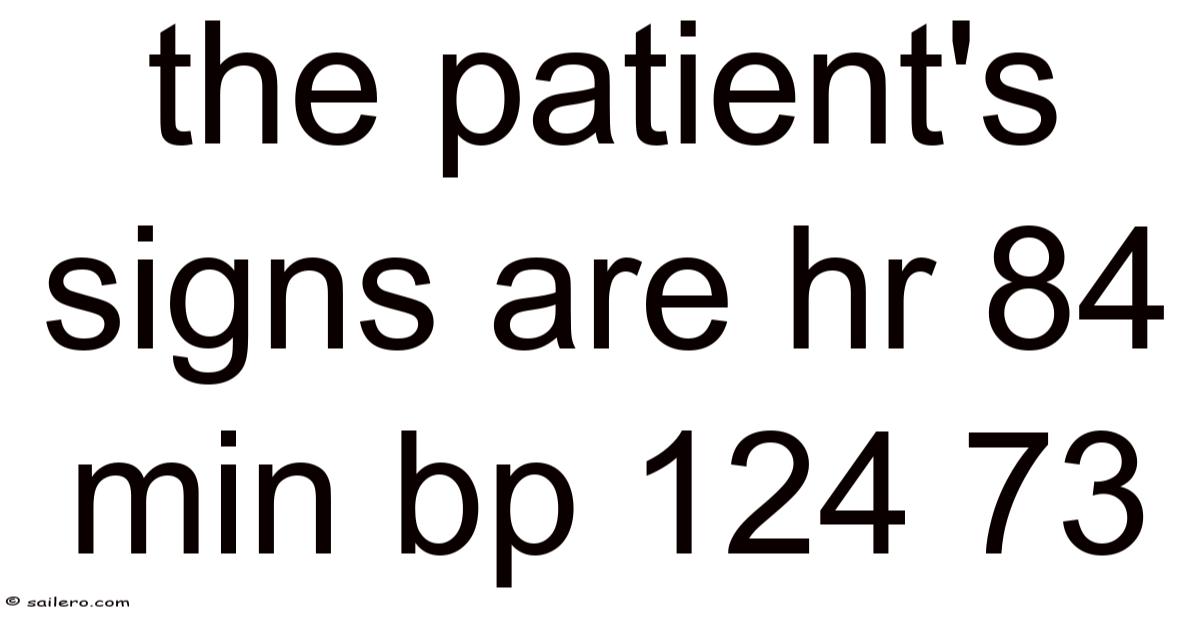
The patient’s clinical presentation often hinges on a delicate interplay between numerous physiological parameters, each contributing subtly yet significantly to the overall health picture. Day to day, understanding their significance requires a nuanced grasp of physiological norms, potential pathophysiological relationships, and the clinical context in which they are observed. Such knowledge empowers clinicians to anticipate complications, tailor interventions, and ultimately enhance patient outcomes. When examining vital signs such as heart rate (HR), blood pressure (BP), and systolic blood pressure (SBP), healthcare professionals must approach these metrics not merely as isolated numbers but as interconnected components of a holistic health profile. This article breaks down the intricacies surrounding these specific values, exploring their clinical relevance, associated conditions, and the nuanced considerations that must guide their interpretation. Day to day, the challenge lies not only in interpreting these figures but also in contextualizing them within the patient’s unique history, comorbidities, and current lifestyle factors. So these numbers, though quantifiable, carry profound implications for diagnostic accuracy and therapeutic decisions. Which means in this context, the values provided—HR at 84 beats per minute, BP measured at 124 mmHg systolic and 73 mmHg diastolic—stand as critical indicators that warrant careful scrutiny. By dissecting each parameter’s role and the collective impact of their interplay, we aim to illuminate pathways toward informed decision-making while underscoring the importance of precision in clinical practice Worth knowing..
Easier said than done, but still worth knowing And that's really what it comes down to..
Understanding the Vital Signs: A Comprehensive Overview
Vital signs serve as the cornerstone of clinical assessment, offering a snapshot of a patient’s physiological state at a given moment. As an example, while a normal HR of 80–100 bpm generally aligns with healthy individuals, deviations from this range can signal underlying issues such as bradycardia or tachycardia. This process demands both technical expertise and clinical intuition, requiring practitioners to balance data-driven analysis with experiential knowledge. On top of that, this variability underscores the necessity of contextualizing numbers within the broader clinical picture. Such distinctions are not trivial, as misinterpretation can lead to misdiagnosis or inappropriate treatment adjustments. In practice, they provide immediate insights into cardiovascular function, fluid balance, and neurological integrity, making them indispensable tools for diagnosing acute or chronic conditions. And the complexity arises from the fact that individual responses vary widely based on age, genetics, medication use, and environmental factors. Such correlations, while not always linear, provide clues that guide clinicians toward exploring potential causes or underlying conditions. A patient with a baseline HR of 90 might present with a normal BP reading, while another with similar BP might exhibit an abnormal HR, necessitating further investigation. Similarly, blood pressure readings, though often perceived as straightforward, carry significant weight when analyzed alongside other parameters. Elevated SBP values, for example, may indicate hypertension, whereas hypotension could point to hypotension or other systemic imbalances. On the flip side, interpreting these metrics demands more than mere numerical observation; it necessitates understanding their relationships, limitations, and variability across populations. What's more, the interplay between HR, BP, and SBP must be considered holistically; for instance, an elevated SBP often correlates with increased HR, suggesting potential stress or cardiac strain. Worth adding: the challenge, therefore, extends beyond simple measurement—it involves synthesizing data into a coherent narrative that informs actionable steps. In essence, mastering the interpretation of vital signs is akin to deciphering a complex language where each value holds potential meaning, and missteps can have cascading effects on patient care Nothing fancy..
Interpreting the Values: Contextualizing HR, BP, and SBP
To effectively interpret the provided metrics—HR 84, SBP 124, and BPR 73—one must first establish a baseline for each parameter within the patient’s demographic and medical history. SBP values, particularly the systolic component, often serve as a primary indicator of cardiovascular health, with elevated readings typically signaling hypertension. To give you an idea, a young adult with no prior health issues might have a normal HR range, while an older individual or someone with a sedentary lifestyle might require closer scrutiny. Still, contextual factors such as recent exercise, stress levels, or medication adherence can alter these readings. Which means similarly, blood pressure values must be evaluated against age-adjusted norms; a BP of 124/73 mmHg could indicate hypertension in a middle-aged individual but may be within acceptable limits for a younger patient. In this scenario, the patient’s history of hypertension or diabetes would necessitate a more nuanced approach, possibly involving additional tests like lipid profiles or glucose levels It's one of those things that adds up..
