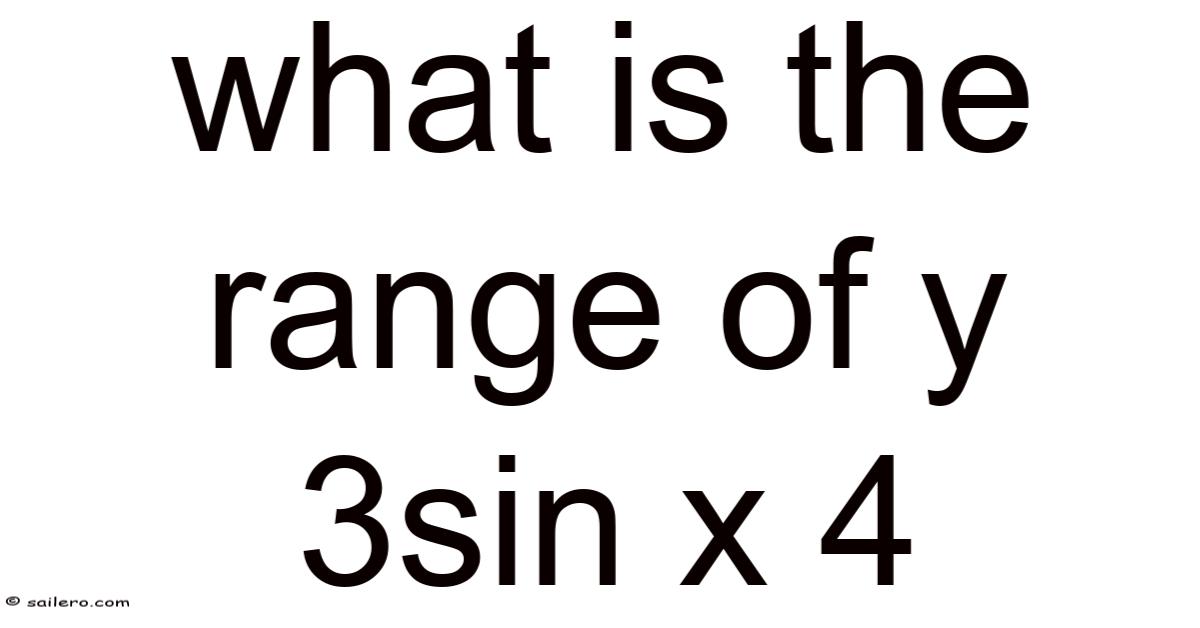
The range of y = 3 sin x + 4 is a fundamental concept in trigonometry that helps students understand how the output of a sinusoidal function behaves. Here's the thing — when we examine this expression, we are looking at a sine wave that has been stretched vertically by a factor of 3 and then lifted upward by 4 units. Day to day, this combination of amplitude and vertical shift determines the smallest and largest values the function can attain, which together define its range. In this article we will explore each component of the equation, walk through the calculation of the range, discuss how to interpret the graph, and answer common questions that arise when studying sinusoidal functions.
Understanding the basic sine function
The sine function, denoted as sin x, is a periodic wave that oscillates between –1 and 1 for all real values of x. This inherent limitation means that, regardless of the input, the output of sin x will always satisfy:
- Maximum value: 1
- Minimum value: –1
Because the sine curve repeats every 2π radians, its behavior is predictable and can be scaled or translated without altering its periodic nature That alone is useful..
Effect of amplitude and vertical shift
In the expression y = 3 sin x + 4, two transformations are applied to the basic sine wave:
-
Amplitude modification – The coefficient 3 in front of sin x changes the height of the wave. Amplitude is defined as the absolute value of the coefficient multiplying the sine term. Thus, the amplitude of our function is |3| = 3. This means the wave now reaches 3 units above and 3 units below its midline Easy to understand, harder to ignore..
-
Vertical shift – The constant +4 moves the entire wave upward by 4 units. This operation does not affect the amplitude but changes the position of the midline, which becomes the line y = 4 Most people skip this — try not to..
When these two transformations are combined, the highest point of the wave occurs when sin x = 1, and the lowest point occurs when sin x = –1. Therefore:
- Maximum y: 3 (1) + 4 = 7
- Minimum y: 3 (–1) + 4 = 1
These calculations give us the range of the function: all y‑values from 1 to 7, inclusive That's the part that actually makes a difference..
Calculating the range step by step
To find the range of any transformed sine function of the form y = A sin x + B, follow these steps:
- Identify the amplitude (A).
- Amplitude = |A|.
- Identify the vertical shift (B).
- This is the constant added to the sine term. 3. Determine the maximum and minimum values.
- Max = B + |A|
- Min = B – |A|
- Write the range as an interval.
- [Min, Max] Applying this procedure to y = 3 sin x + 4:
- Amplitude |A| = 3
- Vertical shift B = 4
- Max = 4 + 3 = 7
- Min = 4 – 3 = 1
Hence, the range is [1, 7] Easy to understand, harder to ignore..
Visual representation and graph interpretationA quick sketch of y = 3 sin x + 4 helps solidify the concept. Imagine the standard sine curve passing through the origin, rising to 1 at π/2, falling back to 0 at π, dipping to –1 at 3π/2, and returning to 0 at 2π. Now stretch the peaks and troughs so they reach 3 units above and below the midline, then slide the entire pattern up by 4 units. The resulting graph will intersect the y‑axis at 4, peak at 7, and trough at 1. This visual makes it clear that no output value outside the interval [1, 7] can ever appear, regardless of the input x.
Common misconceptions
- Misconception: The coefficient 3 changes the period of the function. Reality: The period of sin x remains 2π; only the height (amplitude) changes.
- Misconception: Adding 4 shifts the range to start at 4.
Reality: The vertical shift moves the midline to 4, but the range still expands equally above and below that midline, resulting in 1 – 7. - Misconception: The range includes all real numbers between 1 and 7.
Reality: While the interval notation [1, 7] suggests continuity, the function actually attains every value in that interval because the sine function is continuous and takes every value between –1 and 1.
Practical applications
Understanding the range of y = 3 sin x + 4 is more than an academic exercise; it has real‑world relevance:
- Physics: Modeling alternating current, sound waves, and harmonic motion often involves sinusoidal functions with amplitude and offset. Knowing the range tells engineers the maximum voltage or pressure the system can produce.
- Engineering: In vibration analysis, the
...amplitude determines the maximum displacement of a mechanical system, while the vertical shift represents the equilibrium position. Take this case: a machine part oscillating with y = 3 sin x + 4 would have a maximum displacement of 7 units and a minimum of 1 unit, critical for designing tolerances to prevent component failure Which is the point..
Conclusion
The range of y = 3 sin x + 4 is [1, 7], derived from its amplitude (3) and vertical shift (4). This interval reflects the function’s vertical stretch and upward translation, ensuring all output values lie between these bounds. By analyzing amplitude, midline, and transformations, we avoid common errors and apply this knowledge to fields like engineering and physics, where sinusoidal models are foundational. Understanding the range not only clarifies the function’s behavior but also empowers practical problem-solving in dynamic systems.
The transformation applied to the sine curve is both intuitive and instructive, highlighting how simple adjustments reshape the graph while preserving essential characteristics. By amplifying the wave’s peaks and deepening its valleys, we create a clear boundary around the possible output values—never exceeding 7 or falling below 1. This constraint is vital for applications where precision matters, such as in signal processing or mechanical design No workaround needed..
It’s important to recognize how these changes influence interpretation; what appears as a broad oscillation becomes a tightly bounded function, reinforcing the value of careful analysis. The process also underscores the interplay between mathematical theory and real-world implementation, where understanding ranges prevents miscalculations.
Boiling it down, grasping the range of y = 3 sin x + 4 equips learners with the clarity needed to figure out similar functions confidently. This knowledge not only strengthens theoretical understanding but also enhances practical decision-making across disciplines. By embracing these insights, we ensure accuracy and reliability in modeling dynamic phenomena.
The same principle extends to more nuanced expressions, such as (y = 5\sin(2x - \pi) - 2) or (y = -4\cos x + 6). In each case the amplitude dictates the half‑height of the oscillation, while the vertical shift moves the entire wave up or down. When a horizontal stretch or compression is introduced—through a coefficient multiplying (x) or a phase term—it does not affect the range, because those modifications only alter the speed at which the wave traverses the (x)-axis. Even so, consequently, regardless of how the argument of the trigonometric function is reshaped, the extremal values remain anchored to ( \text{midline} \pm \text{amplitude} ). This invariance is a powerful shortcut: once the amplitude and vertical shift are identified, the exact form of the argument can be ignored for range calculations, allowing analysts to focus on the essential parameters It's one of those things that adds up..
Beyond pure mathematics, recognizing these bounds proves indispensable in fields that rely on periodic data. In acoustics, the maximum pressure deviation of a sound wave determines the loudness ceiling before distortion occurs, guiding the selection of speaker components. In electrical engineering, the peak voltage of an alternating current signal is precisely the upper bound of its sinusoidal model, informing designers about insulation requirements and safety margins. Even in computer graphics, animators use sinusoidal easing functions to simulate natural motion; knowing the exact range ensures that translated coordinates stay within the screen’s viewport, preventing clipping artifacts. By systematically extracting amplitude and vertical shift, professionals can translate abstract equations into concrete specifications that safeguard performance and reliability.
Short version: it depends. Long version — keep reading.
In practice, the ability to predict the range of a transformed sinusoid also streamlines problem‑solving when multiple waves are combined. To give you an idea, when two signals of the form (y_1 = A_1\sin(B_1x + C_1) + D_1) and (y_2 = A_2\sin(B_2x + C_2) + D_2) are superposed, the resultant waveform’s extreme values lie between the sum of the individual minima and the sum of the individual maxima. Which means this additive property, derived directly from the range analysis of each component, enables engineers to anticipate worst‑case scenarios without exhaustive simulation. Such foresight is especially valuable in control systems, where overshoot or undershoot can lead to instability, and in signal processing, where filter design must account for the full spectrum of possible amplitudes.
Understanding the range of a sinusoidal function therefore serves as a unifying thread that connects theoretical exploration with tangible engineering outcomes. Still, it equips students and practitioners alike with a mental checklist—amplitude, vertical shift, and the invariance of range under horizontal transformations—that can be applied instantly to any new example. By internalizing this checklist, one gains confidence in manipulating complex expressions, interpreting graphical behavior, and translating mathematical insight into real‑world solutions Took long enough..
Conclusion
The range of (y = 3\sin x + 4) is ([1,,7]), a direct consequence of its amplitude (3) and vertical shift (4). This interval encapsulates the full spectrum of possible outputs, offering a clear benchmark for analysis across scientific, engineering, and computational domains. Mastery of how transformations affect this range empowers us to predict extremes, design reliable systems, and translate mathematical models into practical innovations, ensuring that every oscillation—no matter how stylized—remains safely bounded within its calculated limits.
