Introduction: Understanding the Importance of Correct mRNA Sequences
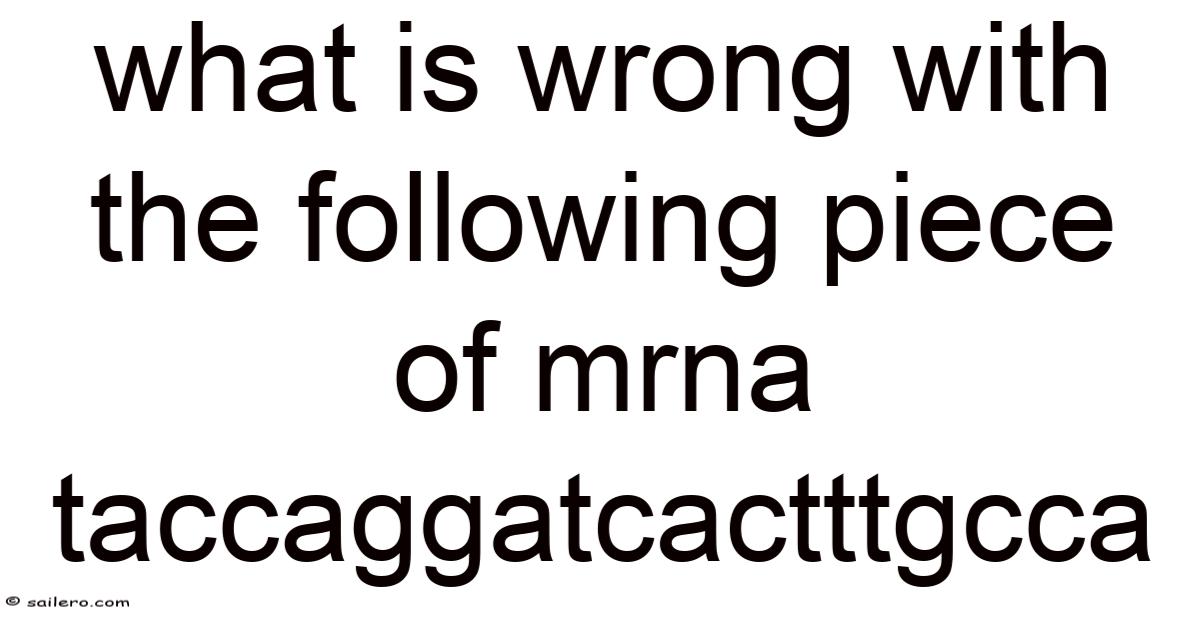
When researchers or students examine a short stretch of messenger RNA (mRNA) such as “taccaggatcactttgcca”, the first question that arises is whether this fragment could realistically function in a living cell. The answer hinges on several molecular‑level criteria: the presence of a proper start codon, the correct reading frame, the avoidance of premature stop codons, appropriate nucleotide composition, and compatibility with the cellular translation machinery. In this article we dissect the given sequence, pinpoint the specific problems that prevent it from being a viable mRNA, and explore the broader principles that govern functional RNA transcripts.
Real talk — this step gets skipped all the time.
1. The Sequence at a Glance
| Position | Nucleotide |
|---|---|
| 1‑3 | tac |
| 4‑6 | cag |
| 7‑9 | gat |
| 10‑12 | cac |
| 13‑15 | ttt |
| 16‑18 | gcc |
| 19‑20 | a |
The string contains 20 nucleotides, which translates to six complete codons plus two extra bases that do not form a full codon. Here's the thing — in the context of protein synthesis, an mRNA must be read in sets of three nucleotides (codons) from a defined start codon (AUG) to a stop codon (UAA, UAG, UGA). Any deviation from this paradigm creates a non‑functional transcript.
2. Lack of a Canonical Start Codon
2.1 Why AUG Matters
The ribosome initiates translation at the AUG codon, which encodes methionine in eukaryotes (formyl‑methionine in prokaryotes). This codon is recognized by the initiator tRNA and sets the reading frame for the entire downstream sequence Still holds up..
2.2 Analysis of the Given Fragment
- The first three nucleotides are tac, which corresponds to the RNA codon UAC (tyrosine).
- No AUG appears in the first six codons, and the only AUG possible would have to start at position 4 (CAG → CAG), which still does not produce an AUG.
Result: The fragment lacks a proper start signal, meaning ribosomes would never begin translation at this site under normal cellular conditions.
3. Incorrect Reading Frame and Incomplete Codons
3.1 Reading Frame Definition
A reading frame is established once the ribosome identifies the start codon. From that point, every subsequent triplet is read in order. Shifting the frame by even a single nucleotide changes every downstream codon.
3.2 Frame Issues in the Sequence
Assuming, hypothetically, that translation could begin at the first nucleotide, the codons would be:
- UAC – Tyrosine
- CAG – Glutamine
- GAT – Aspartate
- CAC – Histidine
- TTT – Phenylalanine
- GCC – Alanine
The remaining “a” is an orphan base that cannot be incorporated into a codon. On top of that, because there is no start codon, the ribosome would not adopt this frame in the first place. If translation were forced to start at a downstream AUG (which does not exist), the entire downstream codon set would shift, producing an entirely different peptide—most likely nonsensical That's the whole idea..
Honestly, this part trips people up more than it should.
Result: The fragment suffers from an undefined reading frame and ends with a dangling nucleotide, both of which are fatal for productive translation.
4. Premature or Missing Stop Codon
4.1 Role of Stop Codons
Translation terminates when the ribosome encounters one of the three stop codons (UAA, UAG, UGA). These signals recruit release factors, prompting the nascent polypeptide to be released That's the whole idea..
4.2 Examination of the Fragment
Within the six complete codons listed above, none correspond to a stop signal. The closest is UAG (amber), but the sequence contains UAC, CAG, GAT, CAC, UUU, GCC—none of which are stop codons. Worth adding, the fragment ends abruptly after the sixth codon, leaving the ribosome without a termination cue.
Result: Even if translation could start, the ribosome would continue past the fragment into downstream RNA (if any) or stall, leading to a non‑terminated polypeptide that is usually targeted for degradation Worth knowing..
5. Nucleotide Composition and Secondary Structure Concerns
5.1 GC Content and Stability
The fragment’s GC content is 45 % (9 G/C out of 20 bases). Day to day, while this is within a typical range, the short length prevents the formation of a stable secondary structure that might protect the mRNA from nucleases. In real transcripts, 5′‑UTR and 3′‑UTR regions often contain hairpins or stem‑loops that influence translation efficiency and stability.
5.2 Potential for Aberrant Structures
If this fragment were part of a larger mRNA, the sequence “caggatc” could potentially form a weak hairpin, but the limited length makes any functional secondary structure unlikely. Also worth noting, the absence of a poly‑A tail (which is essential for nuclear export and translation in eukaryotes) further diminishes the likelihood of a functional mRNA.
Result: The sequence lacks the structural features that contribute to mRNA longevity and translational competence Simple, but easy to overlook. That's the whole idea..
6. Biological Context: Where Might Such a Fragment Appear?
6.1 Random Genomic DNA
Short, random stretches of nucleotides are abundant throughout genomes. The given sequence could simply be a non‑coding intergenic fragment that never gets transcribed, or a piece of intronic RNA that is spliced out and degraded.
6.2 Experimental Artifacts
In laboratory settings, primers or adapters used for PCR or sequencing sometimes contain sequences resembling the one shown. If such a primer were mistakenly interpreted as an mRNA, the errors highlighted above would become apparent Simple as that..
6.3 Synthetic Oligonucleotides
Researchers sometimes design short RNA oligos for siRNA, aptamers, or CRISPR guide RNAs. Those molecules are not meant to be translated, so the lack of a start codon and stop codon is irrelevant. On the flip side, if the intention were to produce a peptide, the design would be fundamentally flawed Took long enough..
7. How to Convert the Fragment into a Viable mRNA
If the goal is to rescue this sequence and make it a functional coding region, the following steps are required:
-
Introduce a Start Codon
- Place AUG at the 5′ end, e.g.,
AUGtaccaggatcactttgcca. - Ensure the Kozak consensus (GCCACC upstream of AUG) for efficient eukaryotic initiation.
- Place AUG at the 5′ end, e.g.,
-
Adjust the Reading Frame
- After the start codon, arrange downstream nucleotides in multiples of three.
- Add two nucleotides after the existing 20‑base stretch to complete the final codon, e.g.,
AUGtaccaggatcactttgcca**UU**.
-
Insert a Stop Codon
- Append UAA, UAG, or UGA at the end of the coding region.
- Example final construct:
AUGtaccaggatcactttgccaUUAAG.
-
Add 5′‑UTR and 3′‑UTR Elements
- Include a 5′ cap analogue and a poly‑A tail (>30 adenines) for stability and translation.
-
Check for Unwanted Motifs
- Scan for cryptic splice sites, internal ribosome entry sites (IRES), or premature polyadenylation signals that could interfere with expression.
By following these design principles, the original fragment can be incorporated into a synthetic mRNA that is competent for translation in vitro or in vivo But it adds up..
8. Frequently Asked Questions
Q1: Can a ribosome start translation without an AUG?
A: In rare cases, alternative start codons (e.g., CUG, GUG) can be used, especially in prokaryotes or viral genomes, but they still require a strong surrounding context. The given fragment lacks any of these alternatives and the necessary surrounding nucleotides, making spontaneous initiation highly improbable.
Q2: Does the orientation of the strand matter?
A: Yes. mRNA is read from the 5′ to 3′ direction. If the fragment were transcribed from the opposite DNA strand, the complementary RNA would be UGGCUUUGUAGUCCUUGA, which still lacks an AUG and a stop codon, so the core issues remain But it adds up..
Q3: Could this sequence be part of a regulatory RNA instead of a coding RNA?
A: Absolutely. Small non‑coding RNAs (sncRNAs) such as microRNAs, siRNAs, or riboswitches often do not contain start/stop codons. In those contexts, the sequence could be functional, but its role would be regulatory, not protein‑coding.
Q4: How does the length of an mRNA affect its function?
A: Functional mRNAs typically contain a 5′‑UTR, a coding sequence (CDS) of at least several dozen codons, and a 3′‑UTR with a poly‑A tail. A 20‑nucleotide fragment is far too short to encode a stable protein and lacks essential untranslated regions That's the whole idea..
Q5: What tools can I use to verify an mRNA design?
A: Bioinformatics platforms such as NCBI ORF Finder, EMBOSS Transeq, and RNAfold can detect open reading frames, predict secondary structures, and flag missing start/stop codons. They are indispensable for troubleshooting synthetic mRNA constructs.
9. Conclusion: The Take‑Home Message
The short RNA fragment taccaggatcactttgcca fails to meet the fundamental requirements of a functional mRNA because it lacks a start codon, possesses an undefined reading frame, ends without a stop codon, and contains an incomplete codon at the 3′ end. Additionally, it does not include the structural features—such as a 5′ cap, Kozak sequence, and poly‑A tail—that are essential for stability and translation in eukaryotic cells But it adds up..
Understanding these deficiencies provides a clear roadmap for anyone looking to design or evaluate mRNA sequences, whether for basic research, therapeutic applications, or educational purposes. By ensuring the presence of a proper initiation site, maintaining a clean reading frame, appending a termination signal, and adding the necessary untranslated regions, a short nucleotide stretch can be transformed from a biologically inert fragment into a strong, translatable mRNA capable of producing functional proteins Small thing, real impact..
