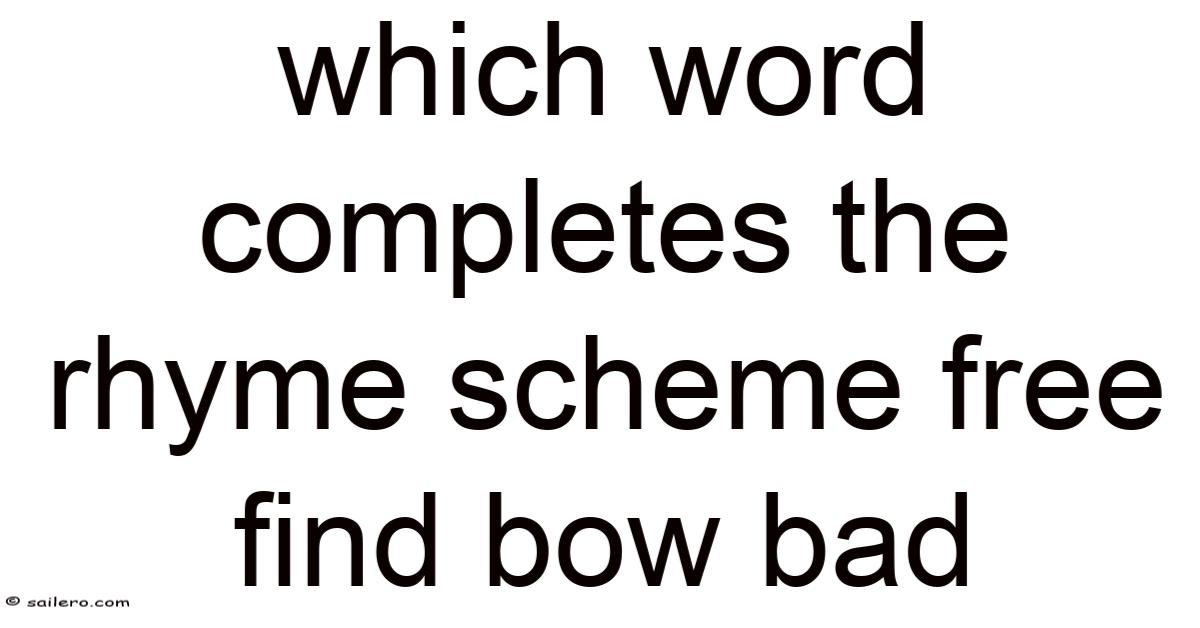
Which Word Completes the Rhyme Scheme: Free Find Bow Bad?
Understanding rhyme schemes is essential for anyone interested in poetry, songwriting, or creative writing. One of the most common rhyme schemes is the AABB pattern, where the first and second lines rhyme, and the third and fourth lines rhyme. Here's the thing — a rhyme scheme refers to the pattern in which the end words of lines rhyme with each other. In the phrase free find bow bad, the challenge is to determine which word best completes this AABB rhyme scheme Simple, but easy to overlook. No workaround needed..
Understanding Rhyme Schemes
A rhyme scheme is typically represented by letters, with each letter corresponding to the sound that the last word of a line makes. Take this: in the AABB scheme, the first and second lines end with rhyming words (denoted by the same letter), and the third and fourth lines end with rhyming words (denoted by another shared letter). This structure creates a sense of rhythm and cohesion in verse.
In the given sequence free find bow bad, the first two words (free and find) clearly rhyme, as they both end with the "ee" sound. This establishes the first part of the AABB pattern. Now, the next step is to identify the rhyme for the third and fourth lines. The word bow ends with the "ow" sound, so the fourth word must rhyme with it. On the flip side, bad ends with the "ad" sound, which does not match the "ow" sound. This mismatch indicates that bad is not the correct word to complete the rhyme scheme.
This changes depending on context. Keep that in mind.
Solving the Rhyme Scheme Puzzle
To solve this puzzle, we must identify a word that rhymes with bow. Still, since the fourth word in the sequence is bad, we need to reconsider the structure. Words like flow, grow, go, and snow all fit this pattern. The key is to recognize that the fourth word must rhyme with the third word (bow). So, the correct word to complete the rhyme scheme is flow, grow, or another word ending in "ow.
If we replace bad with flow, the sequence becomes free find bow flow, which follows the AABB rhyme scheme:
- Line 1: free (A)
- Line 2: find (A)
- Line 3: bow (B)
- Line 4: flow (B)
This creates a cohesive and rhythmic pattern that is both pleasing to the ear and logically consistent.
Why Rhyme Schemes Matter
Rhyme schemes are more than just a structural tool; they play a crucial role in memorability and emotional impact. In children's songs, for example, AABB rhymes help young learners remember lyrics and concepts. In literature, poets use rhyme schemes to reinforce themes, create mood, and guide the reader's interpretation. Understanding how to construct and analyze rhyme schemes enhances one's ability to appreciate and create meaningful verse It's one of those things that adds up..
This is where a lot of people lose the thread Small thing, real impact..
Common Rhyme Schemes in Poetry
While AABB is a popular choice, there are numerous rhyme schemes in poetry. Think about it: the ABAB pattern alternates rhymes between lines, creating a different kind of rhythm. The AABB structure, as seen in our example, is straightforward and effective for storytelling or narrative poetry. Other schemes, such as ABCABC or AABBA, offer even more complexity and can be found in classical poetry and modern songwriting That's the whole idea..
Tips for Identifying Rhyme Schemes
When analyzing a poem or constructing your own, follow these steps:
-
- Assign letters to each unique rhyme sound. Identify the end words of each line.
-
- Match similar sounds, focusing on the last syllable of each word. Look for patterns in the sequence of letters.
Take this: in the phrase free find bow bad, the end words are free, find, bow, and bad. Assigning letters based on rhyme:
- free and find both end with "ee" (A)
- bow ends with "ow" (B)
- bad ends with "ad" (C)
People argue about this. Here's where I land on it.
This results in the pattern AAB C, which is not a standard rhyme scheme. Replacing bad with a word that rhymes with bow (e.g., flow) would correct the pattern to AABB Nothing fancy..
Frequently Asked Questions
Q: What is the purpose of a rhyme scheme in poetry?
A: Rhyme schemes create rhythm, enhance memorability, and reinforce thematic elements. They also guide the reader's emotional response and help structure the poem's flow Small thing, real impact. Simple as that..
Q: Can a rhyme scheme be irregular?
A: Yes, many modern poems use irregular or non-rhyming schemes. On the flip side, understanding traditional patterns like AABB provides a foundation for appreciating more complex structures.
Q: How do I choose the right word to complete a rhyme scheme?
A: Focus on the end sound of the previous line. Use a rhyming dictionary or thesaurus to find words that match the desired sound. Prioritize clarity and meaning alongside rhyme.
Q: Is it important for all lines to rhyme in a poem?
A: No, not all poems require rhyming. Free verse, for example, relies on other elements like imagery and rhythm. Rhyme schemes are a tool, not a requirement Turns out it matters..
Conclusion
The word that completes the rhyme scheme free find bow bad is one that rhymes with **bow
When the final line mustecho the sound of bow, the poet is essentially presented with a small palette of possibilities—glow, flow, know, low, show, though, crow, though, hero (the latter sharing the “‑ow” nucleus). Each choice carries its own shade of meaning, and the decision should be guided by three considerations:
Worth pausing on this one Less friction, more output..
- Semantic fit – Does the word slot naturally into the line’s sense? If the preceding line speaks of a sunrise, glow or show may feel organic, whereas crow would introduce an unexpected visual.
- Emotional resonance – A word that evokes the intended mood can deepen the poem’s impact. Know suggests revelation, low hints at melancholy, while flow conveys movement and ease.
- Phonetic harmony – Even within the same rhyme family, subtle differences in stress and vowel length can affect the line’s rhythm. Glow carries a single syllable with a long “o,” while though adds a soft “th” that may stretch the beat.
Let’s illustrate with a brief example that builds on the original fragment:
The night was free, the wind find,
A silver arrow bow, its tip glow.
Here, glow not only rhymes with bow but also reinforces the visual of a luminous arrow, tying the two lines together thematically. If the poet wishes to shift tone, low could be substituted:
The night was free, the wind find,
A silver arrow bow, its tip low.
In this version, low introduces a more subdued, perhaps ominous, atmosphere, showing how a single rhyming word can pivot the poem’s emotional trajectory The details matter here..
Practical Strategies for Selecting the Perfect Rhyme
- Brainstorm in clusters: Write down every word that shares the target rhyme, then filter by relevance.
- Read aloud: Hearing the line helps detect awkward pauses or unintended stresses.
- Test alternatives: Swap a candidate into the line and see whether the surrounding words still flow naturally.
- Consider connotation: A rhyme that sounds pleasant may still be unsuitable if its meaning clashes with the poem’s narrative.
By treating rhyme as a collaborative partner rather than a mechanical constraint, poets can wield it to amplify both structure and substance.
Conclusion
Understanding how to complete and manipulate rhyme schemes equips writers with a versatile tool for shaping verse. On top of that, whether adhering to a strict AABB pattern or experimenting with looser pairings, the careful selection of rhyming words can tighten rhythm, clarify imagery, and steer the reader’s emotional response. Mastery of these techniques transforms a simple string of lines into a cohesive, resonant piece of poetry—one where every sound, from free to find, from bow to its perfect rhyming partner, works in concert to create a memorable musical experience.
