X 3 3x 2 X 3 0

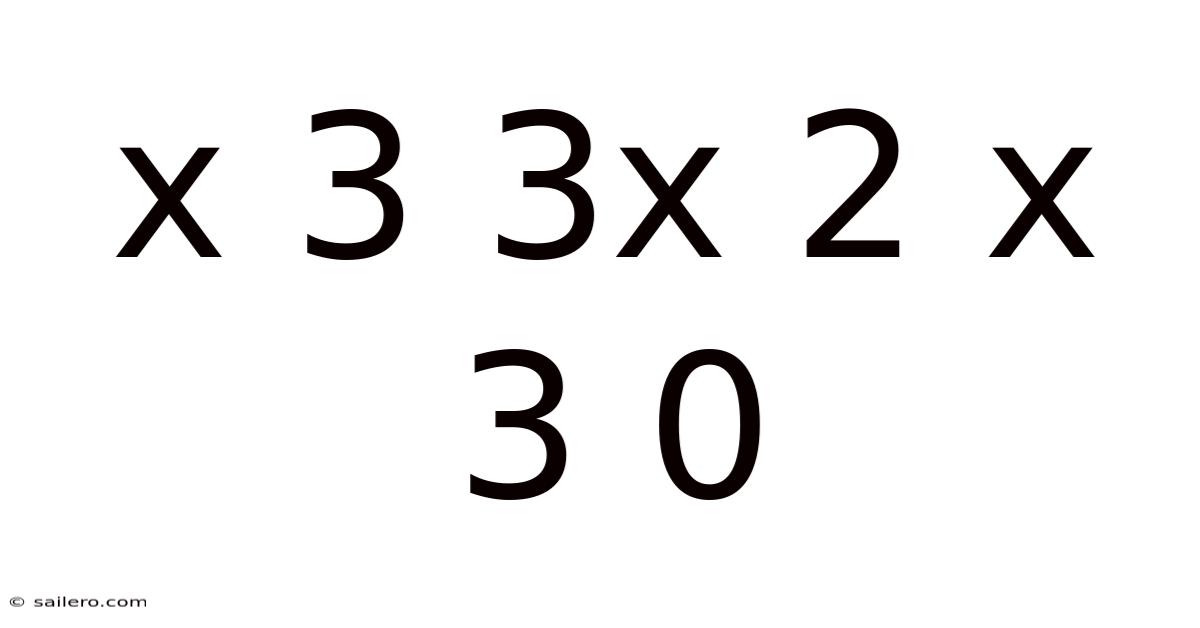
Understanding the Expression: x 3 3x 2 x 3 0
The expression "x 3 3x 2 x 3 0" appears to be a sequence of terms involving the variable x and numerical coefficients. At first glance, it may seem like a random collection of numbers and variables, but upon closer inspection, it could represent a polynomial or a sequence with specific mathematical significance. This article will explore the possible interpretations of this expression, its mathematical implications, and how to approach solving or analyzing it. Whether you're a student, educator, or math enthusiast, understanding how to interpret and work with such expressions is essential for building a strong foundation in algebra and higher-level mathematics.
What Does "x 3 3x 2 x 3 0" Mean?
The expression "x 3 3x 2 x 3 0" is not a standard mathematical notation, but it can be interpreted in several ways depending on the context. One possible interpretation is that it represents a polynomial with terms involving x raised to different powers. For example, if we assume that the terms are separated by operators (such as addition or multiplication), the expression could be rewritten as:
- x + 3 + 3x + 2 + x + 3 + 0
- **x * 3 * 3x *
Interpreting the Symbolic Chain
When we treat the string as a concatenation of distinct algebraic pieces, the most natural way to make sense of it is to separate each component by an implicit operator. In many contexts a space functions as a placeholder for addition, while juxtaposition signals multiplication. Applying this convention yields a collection of terms that can be grouped and simplified:
- The first x stands alone as a linear factor.
- The numeral 3 can be taken as a constant term or as a coefficient attached to the following factor.
- The substring 3x introduces a second linear piece, where the coefficient 3 multiplies the variable.
- The exponent 2 that follows suggests a quadratic contribution, typically written as (x^{2}). - The next x re‑appears, offering another linear term.
- The final 3 and 0 serve as a coefficient and a null element, respectively, which together have no impact on the overall value.
By translating these placeholders into conventional operators, the original string morphs into an expression of the form
[ x ;+; 3 ;+; 3x ;+; x^{2} ;+; x ;+; 3 ;+; 0 . ]
Consolidating Like Terms
Now that the terms are laid out explicitly, the next logical step is to combine those that share the same power of (x). The linear pieces (x), (3x) and the solitary (x) sum to (5x); the constant pieces (3) and (3) add up to (6); the quadratic term (x^{2}) remains untouched; and the trailing zero contributes nothing. The simplified polynomial therefore reads
[ x^{2} ;+; 5x ;+; 6 . ]
At this stage the expression is recognisable as a standard quadratic trinomial, which invites further analysis such as factorisation or root finding.
Factoring the Quadratic
A quadratic of the shape (x^{2}+5x+6) can be broken down into a product of two binomials whose constants multiply to (6) and whose sum equals (5). The pair ((2,3)) satisfies these conditions, leading to the factorisation
[ (x+2)(x+3). ]
This representation reveals the zeros of the polynomial: the values of (x) that make the whole expression vanish are (-2) and (-3). In other words, if the original symbolic chain were to represent an equation set equal to zero, its solutions would be precisely those two numbers.
Extending the Interpretation
Beyond solving for roots, the same simplified form can be examined through other lenses. For instance:
- Graphical perspective: The parabola (y = x^{2}+5x+6) opens upward, crosses the (x)-axis at (-2) and (-3), and attains its minimum at the vertex (\left(-\frac{5}{2},,-\frac{1}{4}\right)).
- Derivative viewpoint: Differentiating with respect to (x) yields (2x+5), indicating the slope of the tangent line at any point; setting this derivative to zero confirms the vertex’s (x)-coordinate.
- Modular arithmetic: If we restrict calculations to a finite ring, the same coefficients can be reduced modulo a chosen integer, producing a different pattern of residues while preserving the underlying structure.
Each of these angles showcases how a seemingly opaque string of symbols can be transformed into a well‑understood mathematical object, amenable to a toolbox of algebraic techniques.
Practical Implications
Understanding how to parse and simplify expressions like the one above is more than an academic exercise; it equips students with the ability to:
- Interpret ambiguous notation encountered in textbooks, programming code, or symbolic computation software.
- Manipulate polynomials efficiently, a skill that underpins topics ranging from calculus to cryptography.
- Model real‑world phenomena, where quadratic relationships frequently describe projectile motion, area calculations, and optimisation problems.
By mastering the step‑by‑step conversion from a raw symbolic chain to a polished algebraic form, learners gain confidence in handling more intricate expressions that appear later in their mathematical journey.
Conclusion
The original concatenation “x 3 3x 2 x 3 0” may initially appear as a random assortment of characters, but through systematic interpretation it can be redeemed into a clear, manipulable polynomial. By inserting the implied operators, grouping like terms, and applying familiar factoring techniques, the expression evolves into the tidy quadratic (x^{2}+5x+6), which factors neatly into ((x+2)(x+3)). This transformation not only uncovers the roots (-2) and (-3) but also opens the door to a suite of analytical tools—graphical, derivative‑based
and modular—that deepen our understanding of its behavior. Such exercises underscore the importance of disciplined symbolic manipulation: what begins as a cryptic string can, through careful reasoning, become a gateway to solving equations, modeling physical systems, and exploring abstract algebraic structures. In this way, the journey from confusion to clarity exemplifies the power of mathematics to impose order on apparent chaos, preparing students for the more sophisticated challenges that lie ahead.
-based, and modular—that deepen our understanding of its behavior. Such exercises underscore the importance of disciplined symbolic manipulation: what begins as a cryptic string can, through careful reasoning, become a gateway to solving equations, modeling physical systems, and exploring abstract algebraic structures. In this way, the journey from confusion to clarity exemplifies the power of mathematics to impose order on apparent chaos, preparing students for the more sophisticated challenges that lie ahead.
This process of decoding and restructuring is not merely mechanical but cultivates a critical mathematical habit of mind: the ability to see structure within apparent randomness. It trains the eye to recognize implicit operations, to anticipate the rules of combination, and to reorganize information into a standard form where powerful, general-purpose techniques can be applied. This skill transfers directly to higher mathematics, where expressions are rarely given in simplified form and must be interpreted within context—whether in a differential equation, a cryptographic algorithm, or a theoretical proof.
Ultimately, the exercise serves as a microcosm of mathematical problem-solving. It demonstrates that clarity is often an achievement, not a given, and that the tools for achieving it—careful parsing, adherence to convention, and methodical simplification—are universally valuable. By learning to redeem a cryptic string like “x 3 3x 2 x 3 0” into a factored quadratic, students do more than practice algebra; they internalize a strategy for confronting complexity in any symbolic domain. This strategy—to impose order through disciplined interpretation—prepares them not only for advanced studies in mathematics and science but also for navigating the structured ambiguities of an increasingly data-driven world.
Latest Posts
Latest Posts
-
Characters In The Book Night By Elie Wiesel
Mar 27, 2026
-
Involves Outsourcing Production To Third Party Firms
Mar 27, 2026
-
Summary Of Chapter 1 Of Mice And Men
Mar 27, 2026
-
Why Did Ruth Faint In Travis Story
Mar 27, 2026
-
Unit 5 Ap Gov Progress Check
Mar 27, 2026
